
Have you ever recited this phrase daily without truly knowing what you were declaring?
Auzubillah minashaitan nirajeem meaning in Urdu is something every Muslim should know with full clarity not just as a translation, but as a living understanding. This phrase is recited before every Quran recitation, in the opening of Salah, and in moments of anger, fear, or spiritual vulnerability. Yet many Muslims recite it as a habit rather than a conscious act of seeking Allah’s protection.
This phrase is not tradition. It is a direct Quranic command. Allah ordered its recitation before His own words which alone reveals how critical it is for a believer’s spiritual protection.
Here you finds the complete Arabic text, authentic word-by-word meaning, verified hadith, correct usage, and practical situations where this phrase makes a real difference all in clear, simple language.
| Detail | Information |
|---|---|
| Arabic Text | أَعُوذُ بِاللَّهِ مِنَ الشَّيْطَانِ الرَّجِيمِ |
| Transliteration | A’udhu billahi minash-shaytanir rajeem |
| Urdu Meaning | میں اللہ کی پناہ مانگتا ہوں شیطان مردود سے |
| English Meaning | I seek refuge in Allah from the accursed Shiatan |
| Quranic Source | Surah An-Nahl, 16:98 |
| When to Recite | Before Quran, in prayer, during anger, at night |
| Status | Quranic command not optional before recitation |
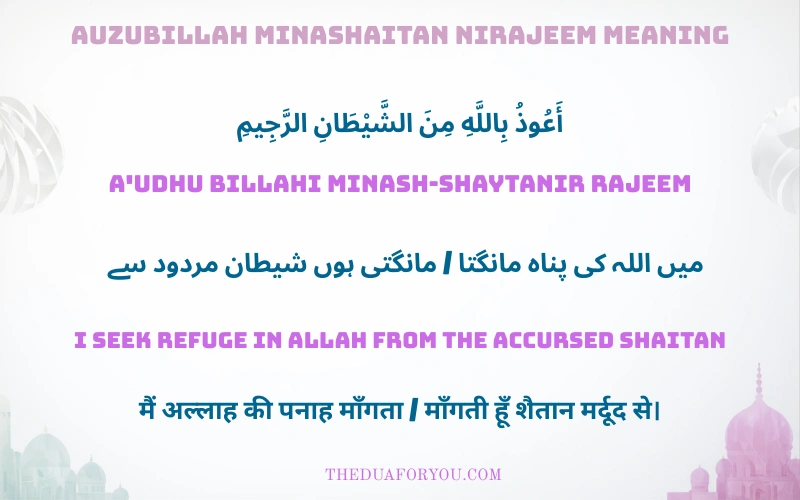
Auzubillah Minashaitan Nirajeem Meaning
Arabic:
أَعُوذُ بِاللَّهِ مِنَ الشَّيْطَانِ الرَّجِيمِ
Transliteration:
A’udhu billahi minash-shaytanir rajeem
Auzubillah minashaitan nirajeem meaning in Urdu:
“میں اللہ کی پناہ مانگتا / مانگتی ہوں شیطان مردود سے”
Auzubillah minashaitan nirajeem meaning in English:
“I seek refuge in Allah from the accursed Shiatan.”
Auzubillah minashaitan nirajeem meaning in Hindi:
“मैं अल्लाह की पनाह माँगता / माँगती हूँ शैतान मर्दूद से।”
Word-by-Word Breakdown
Every word in auzubillah minashaitan nirajeem carries precise theological meaning. Here is a complete breakdown:
| Arabic Word | Transliteration | Urdu Meaning | English Meaning |
|---|---|---|---|
| أَعُوذُ | A’udhu | میں پناہ مانگتا ہوں | I seek refuge / I take shelter |
| بِاللَّهِ | Billahi | اللہ کے ساتھ | In Allah / Through Allah |
| مِنَ | Mina | سے | From |
| الشَّيْطَانِ | Ash-Shaytani | شیطان | Shiatan |
| الرَّجِيمِ | Ar-Rajeem | مردود / راندہ درگاہ | The Accursed / The Expelled |
Three points most people overlook:
First – the word “A’udhu” does not mean a casual request. In classical Arabic, it means to cling tightly to something for protection the way a child grabs hold of a parent in fear. When you say it, you are running to Allah, not simply asking Him politely.
Second – “Billahi” uses the preposition “bi” which indicates attachment and reliance. You are not seeking refuge through a middleman. You are attaching yourself directly to Allah.
Third – “Ar-Rajeem” comes from the Arabic root “rajm” meaning to be pelted with stones, cast out, expelled permanently. This word describes Shaytan’s permanent status: expelled from Allah’s mercy, defeated, and disgraced. Saying this phrase is a reminder that the enemy you fear has already been humiliated by the One you are turning to.
The Quranic Command – This Is Not Optional
Allah stated in the Holy Quran:
فَإِذَا قَرَأْتَ الْقُرْآنَ فَاسْتَعِذْ بِاللَّهِ مِنَ الشَّيْطَانِ الرَّجِيمِ
Transliteration: Fa-idha qara’tal Qur’ana fasta’idh billahi minash-shaytanir rajeem
Urdu Translation: “پس جب تم قرآن پڑھو تو اللہ کی پناہ مانگو شیطان مردود سے۔”
English Translation: “So when you recite the Quran, seek refuge with Allah from Shiatan, the expelled.” (Surah An-Nahl, 16:98)
This verse carries three important facts:
The word used is “fasta’idh” a command form in Arabic. Allah is not suggesting this. He is commanding it. Scholars of Tafsir, including Ibn Kathir and Al-Qurtubi, confirm that reciting auzubillah minashaitan nirajeem before Quran recitation is obligatory for every Muslim.
Allah placed this command before the recitation of His own words which means Shaytan specifically targets the mind of a person engaging with the Quran. This phrase is your spiritual barrier before that engagement begins.
Hadith: What the Prophet ﷺ Taught About This Phrase
Hadith 1: The Cure for Anger
أَعُوذُ بِاللَّهِ مِنَ الشَّيْطَانِ الرَّجِيمِ
The Prophet ﷺ said:
“Inni la’alamu kalimatan law qalaha ladhahaba anhu ma yajidu, law qala: A’udhu billahi minash-shaytanir rajeem.”
إِنِّي لَأَعْلَمُ كَلِمَةً لَوْ قَالَهَا لَذَهَبَ عَنْهُ مَا يَجِدُ، لَوْ قَالَ: أَعُوذُ بِاللَّهِ مِنَ الشَّيْطَانِ الرَّجِيمِ
English Meaning: “I know a word that, if he were to say it, what he is feeling would leave him if he said: I seek refuge in Allah from the accursed Shiatan.” (Sahih al-Bukhari, Hadith 3282; Sahih Muslim, Hadith 2610)
This was said when the Prophet ﷺ witnessed two men in a heated argument. He did not prescribe patience alone he prescribed this specific phrase. Anger is one of Shaytan’s primary entry points into the human heart, and this phrase directly addresses that.
Hadith 2: Protection From Waswasah (Whispers) in Prayer
إِذَا وَجَدَ أَحَدُكُمْ وَسْوَسَةً فَلْيَسْتَعِذْ بِاللَّهِ مِنَ الشَّيْطَانِ الرَّجِيمِ وَلْيَتْفِلْ عَنْ يَسَارِهِ ثَلَاثًا
“Idha wajada ahadukum waswa Shiatan fal-yasta’idh billahi minash-shaytanir rajeem, wal-yatful ‘an yasarihi thalathan.”
English Meaning: “When any one of you feels whispering from Shaytan, let him seek refuge in Allah from the accursed Shiatan and spit lightly to his left three times.” (Sahih Muslim, Hadith 2203)
Intrusive thoughts during prayer are Shaytan’s direct interference. The Prophet ﷺ gave this specific prescription not a longer supplication, not a complicated ritual. Just this phrase, said with sincerity.
Hadith 3: Entering the Toilet
اللَّهُمَّ إِنِّي أَعُوذُ بِكَ مِنَ الْخُبُثِ وَالْخَبَائِثِ
“Allahumma inni a’udhu bika minal khubuthi wal khaba’ith.”
English Meaning: “O Allah, I seek refuge in You from male and female devils.” (Sahih al-Bukhari, Hadith 142; Sahih Muslim, Hadith 375)
The Prophet ﷺ recited this specific dua before entering the toilet a place where evil spirits gather. This is an extension of the same principle of auzubillah: seeking direct refuge in Allah before entering vulnerable situations.
Hadith 4: Protection at Night and From Evil Creation
أَعُوذُ بِكَلِمَاتِ اللَّهِ التَّامَّاتِ مِنْ شَرِّ مَا خَلَقَ
“A’udhu bikalimati Allahit-tammati min sharri ma khalaq.”
English Meaning: “I seek refuge in the perfect words of Allah from the evil of what He has created.” (Sahih Muslim, Hadith 2708)
The Prophet ﷺ recommended this dua when stopping at any place during travel, at night, or in unfamiliar surroundings. It is a broader form of seeking refuge, covering all created evil including Shaytan, harmful animals, and unseen harm.
Hadith 5: Extended Form of Taawwudh (Longer Version)
أَعُوذُ بِاللَّهِ السَّمِيعِ الْعَلِيمِ مِنَ الشَّيْطَانِ الرَّجِيمِ مِنْ هَمْزِهِ وَنَفْخِهِ وَنَفْثِهِ
“A’udhu billahis-Sami’il-‘Alimi minash-shaytanir rajeem, min hamzihi wa nafkhihi wa nafthihi.”
English Meaning: “I seek refuge in Allah, the All-Hearing, the All-Knowing, from the accursed Shiatan from his madness, his arrogance, and his poetry.” (Abu Dawud, Hadith 775; At-Tirmidhi, Hadith 242 graded Hasan)
This is the auzubillah minashaitan nirajeem full extended version recited specifically at the beginning of Salah before Surah Al-Fatihah. “Hamz” refers to madness or distraction caused by Shaytan. “Nafkh” refers to arrogance he whispers into the heart. “Nafth” refers to the poetry and falsehood he inspires. All three are specific weapons of Shaytan that this dua directly names and rejects.
Read Also: Pet Dard Ki Dua in quran
When to Recite: Practical Situations With Evidence
| Situation | Ruling | Source |
|---|---|---|
| Before Quran recitation | Obligatory (Wajib) | Surah An-Nahl, 16:98 |
| In Salah first rak’ah | Sunnah | Abu Dawud, Hadith 775 |
| During anger | Strongly recommended | Sahih Bukhari, Hadith 3282 |
| When experiencing waswasah | Prescribed | Sahih Muslim, Hadith 2203 |
| Before entering the toilet | Prescribed | Sahih Bukhari, Hadith 142 |
| At night or in unfamiliar places | Recommended | Sahih Muslim, Hadith 2708 |
| When Shaytan appears in dreams | Recommended | Sahih Muslim, Hadith 2708 |
Spiritual Benefits: What This Phrase Actually Does
It creates a direct barrier between you and Shaytan. Shaytan’s influence depends on a believer’s heedlessness. The moment you consciously seek Allah’s protection, you are actively shutting his entry point.
It is an independent act of worship. Islamic scholars including Ibn Al-Qayyim have stated that the Taawwudh is not merely a preparatory phrase it is ibadah in itself. Every sincere recitation carries reward.
It resets your spiritual state before Allah’s words. Reciting auzubillah minashaitan nirajeem before the Quran shifts your mental and spiritual focus. You are signaling to your heart: what follows is sacred, and you are approaching it under divine protection.
It addresses the root of most sins. Surah An-Nas (114:4-5) identifies Shaytan as the one who whispers into human hearts. Most sins begin with a whisper. This phrase attacks that whisper before it takes hold.
Mistakes to Avoid
Reciting without understanding. Knowing auzubillah minashaitan nirajeem meaning in Urdu or English is what turns this from a habit into a conscious act of turning to Allah.
Skipping it before Quran recitation. Many go straight to Bismillah. The correct Sunnah order is Taawwudh first, then Tasmiyah, then recitation and all three have distinct roles.
Forgetting it during anger. That is precisely when Shaytan is most active. The Prophet ﷺ specifically prescribed this phrase for anger yet it is most often forgotten in that very moment.
Saying it only in Arabic without reflection. The Arabic must be pronounced correctly, but the heart must be present with the meaning. Both together are what make this phrase spiritually effective.
Pros and Cons of Reciting Without Understanding vs With Understanding
| Recitation Without Understanding | Recitation With Full Understanding |
|---|---|
| Still carries reward as dhikr | Carries greater reward conscious ibadah |
| Does not engage the heart fully | Engages both heart and tongue |
| Habitual may become mechanical | Intentional remains alive and meaningful |
| Basic protection | Full spiritual benefit realized |
| Common among most Muslims | Practiced by those who study its meaning |
Conclusion
Auzubillah minashaitan nirajeem is not a ritual opener. It is a direct declaration made to Allah that you are aware of Shaytan’s presence, that you reject his influence, and that you are choosing Allah’s protection with full consciousness.
Every Muslim who understands auzubillah minashaitan nirajeem meaning in Urdu word by word, with its Quranic backing and Prophetic context will never recite it the same way again. These are not simply words you say before reading. They are the words through which you tell Allah: I am here, I am aware, and I choose You.
May Allah protect every Muslim from the whispers of Shaytan and keep their hearts firm on His remembrance. Ameen.
? Frequently Asked Questions
Q: What is auzubillah minashaitan nirajeem meaning in Urdu?
The meaning in Urdu is: “میں اللہ کی پناہ مانگتا / مانگتی ہوں شیطان مردود سے” I seek refuge in Allah from the accursed Shiatan.
Q: What is the correct Arabic text of auzubillah minashaitan nirajeem?
The correct Arabic text is: أَعُوذُ بِاللَّهِ مِنَ الشَّيْطَانِ الرَّجِيمِ
Q: Is reciting this phrase obligatory before Quran recitation?
Yes. The majority of Islamic scholars including the Hanafi, Shafi’i, and Hanbali schools hold that reciting it before Quran recitation is obligatory, based on the direct command in Surah An-Nahl (16:98).
Q: Should it be recited aloud or silently?
In Salah, it is recited silently. Outside of prayer, both are acceptable. Silent recitation is more common in personal settings.
Q: What does “Rajeem” specifically mean?
“Rajeem” comes from the Arabic root “rajm” to be pelted or cast out. It describes Shaytan as permanently expelled from Allah’s mercy. It is not just a description of his nature it is a statement of his defeat.
Q: Can women recite auzubillah minashaitan nirajeem?
Yes, without any restriction. This phrase applies equally to all Muslims regardless of gender, age, or circumstance.
Q: Is there a longer version of auzubillah minashaitan nirajeem?
Yes. The extended authenticated version is: أَعُوذُ بِاللَّهِ السَّمِيعِ الْعَلِيمِ مِنَ الشَّيْطَانِ الرَّجِيمِ مِنْ هَمْزِهِ وَنَفْخِهِ وَنَفْثِهِ (Abu Dawud, Hadith 775 graded Hasan) This version is specifically recommended at the beginning of Salah.