Surah Zilzal (Chapter 99) describes the Day of Judgment when the earth will shake violently and reveal all human deeds. This Makki surah contains 8 verses emphasizing accountability.
When the ground beneath your feet trembles, fear grips your heart instantly. Now imagine the earth shaking with such intensity that it throws out everything buried within it every secret, every hidden deed, every forgotten action coming to light.
Surah Zilzal paints this exact scene, not to terrify, but to awaken conscience. This powerful chapter from the Quran addresses the reality every soul will face complete accountability for actions, no matter how small. Whether you’re seeking spiritual growth, understanding Quranic wisdom, or simply curious about this profound chapter, this comprehensive guide covers everything you need to know about Surah Zilzal with authentic sources and practical applications.
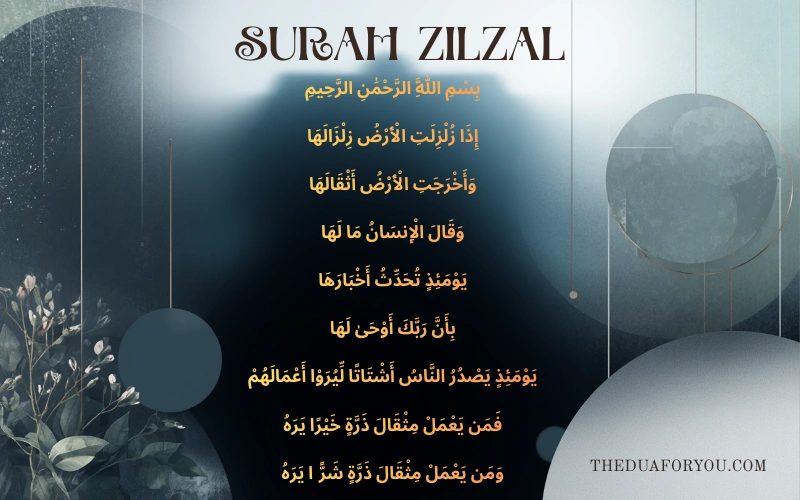
Complete Surah Zilzal in Arabic
بِسْمِ اللَّهِ الرَّحْمَٰنِ الرَّحِيمِ
إِذَا زُلْزِلَتِ الْأَرْضُ زِلْزَالَهَا
وَأَخْرَجَتِ الْأَرْضُ أَثْقَالَهَا
وَقَالَ الْإِنسَانُ مَا لَهَا
يَوْمَئِذٍ تُحَدِّثُ أَخْبَارَهَا
بِأَنَّ رَبَّكَ أَوْحَىٰ لَهَا
يَوْمَئِذٍ يَصْدُرُ النَّاسُ أَشْتَاتًا لِّيُرَوْا أَعْمَالَهُمْ
فَمَن يَعْمَلْ مِثْقَالَ ذَرَّةٍ خَيْرًا يَرَهُ
وَمَن يَعْمَلْ مِثْقَالَ ذَرَّةٍ شَرًّا يَرَهُ
Surah Zilzal with Transliteration and Meaning
Verse 1: Izaa zul zilatil ardu zil zaalaha
Translation: When the earth is shaken with its (final) earthquake.
Verse 2: Wa akhrajatil ardu athqaalaha
Translation: And the earth throws out its burdens.
Verse 3: Wa qaalal insaanu maa laha
Translation: And man says, “What is wrong with it?”
Verse 4: Yawma izin tuhaddithu akhbaaraha
Translation: That Day it will declare its information.
Verse 5: Bi-anna rabbaka awhaa laha
Translation: Because your Lord has commanded it.
Verse 6: Yawma izin yasduru annaasu ashtaatal liyuraw a’maalahum
Translation: That Day, people will proceed in scattered groups to be shown their deeds.
Verse 7: Faman ya’mal mithqaala zarratin khayran yarah
Translation: So whoever does an atom’s weight of good will see it.
Verse 8: Wa man ya’mal mithqaala zarratin sharran yarah
Translation: And whoever does an atom’s weight of evil will see it.
Context and Background of Revelation
Surah Zilzal was revealed in Makkah during the early period of Prophet Muhammad’s (peace be upon him) mission. The Makkan period focused heavily on establishing core beliefs: Tawheed (monotheism), prophethood, and the afterlife. This surah specifically addresses the third pillar accountability in the Hereafter.
The chapter takes its name from the first word “زُلْزِلَتْ” (zul zilat), meaning “shaken” or “earthquake.” Classical scholars like Ibn Kathir and Al-Qurtubi confirm its Makkan origin, though some narrations suggest certain verses may have been revealed in Madinah. The consensus remains that the surah’s primary revelation occurred in Makkah.
Historical Context: Early Muslims faced severe persecution. This surah provided comfort by reminding them that every sacrifice, every hardship endured for faith, would be accounted for even the smallest good deed would not go unrewarded.
Surah Zilzal in English: Detailed Verse-by-Verse Analysis
Verses 1-3: The Catastrophic Event
The opening describes an earthquake unlike any experienced on earth. The Arabic word “زِلْزَالَهَا” (zil zaalaha) uses emphatic repetition the earth’s ultimate, final shaking. This isn’t a natural disaster; it’s the cosmic announcement of time’s end.
When the earth “throws out its burdens,” it refers to everything buried within corpses, treasures, secrets, evidence of all that occurred on its surface. Humanity’s reaction? Confusion and terror: “What is wrong with it?”
Practical Application: This imagery serves as a conscience check. If hidden deeds will eventually surface, living with integrity becomes not just moral but practical.
Verses 4-5: Earth as a Witness
The earth itself will testify. Islamic scholars interpret this as the earth speaking by Allah’s command, revealing what took place upon it. According to authentic hadith collections (Ahmad and Tirmidhi), Prophet Muhammad (peace be upon him) said: “Do you know what its news is? Its news is that it will testify against every male and female slave about what they did on its surface.”
Warning: This establishes divine justice’s completeness. No crime goes unwitnessed, no good deed unrecorded.
Verse 6: Scattered Emergence
People will emerge from graves in scattered groups based on their deeds. Some interpretations suggest groups based on belief systems, others based on the nature of actions performed. The purpose? To witness the precise record of their earthly lives.
Verses 7-8: The Atomic Scale of Justice
These final verses contain Surah Zilzal’s revolutionary message: absolute accountability down to the atomic level.
The Arabic “مِثْقَالَ ذَرَّةٍ” (mithqaala zarratin) means “the weight of an atom” or “smallest particle.” Before modern science identified atoms, the Quran used this term to convey the most minute quantity imaginable.
Trade-off Analysis:
- Benefit: Even tiny good deeds count smiling at someone, removing harm from a path, a kind word.
- Warning: Small sins also accumulate. Gossip, minor dishonesty, overlooked injustices all recorded.
Classical scholar Al-Ghazali emphasized this reality changed his life, making him hyper-aware of seemingly insignificant actions that shaped character and destiny.
Surah Zilzal with Urdu Translation
آیت 1: جب زمین اپنے زلزلے سے ہلا دی جائے گی۔
آیت 2: اور زمین اپنے اندر کے بوجھ باہر نکال دے گی۔
آیت 3: اور انسان کہے گا کہ اسے کیا ہو گیا؟
آیت 4: اس دن وہ اپنے حالات بیان کرے گی۔
آیت 5: کیونکہ تیرے رب نے اسے حکم دیا ہوگا۔
آیت 6: اس دن لوگ مختلف جماعتوں میں لوٹائے جائیں گے تاکہ انہیں ان کے اعمال دکھائے جائیں۔
آیت 7: پھر جس نے ذرہ برابر نیکی کی ہوگی وہ اسے دیکھ لے گا۔
آیت 8: اور جس نے ذرہ برابر برائی کی ہوگی وہ اسے دیکھ لے گا۔
Spiritual Benefits and Practical Wisdom
For Daily Consciousness
Reciting Surah Zilzal develops heightened awareness of actions. Modern psychology calls this “mindfulness” the Quran established it 1,400 years ago through verses like these.
Actionable Practice:
- Recite after Fajr (dawn prayer) to start your day with accountability consciousness.
- Reflect on verse 7-8 before sleep review your day’s actions honestly.
- Teach children these verses early; it builds intrinsic moral development.
For Overcoming Procrastination in Good Deeds
Many delay charity, reconciliation, or kindness thinking “I’ll do it later when I have more.” Surah Zilzal’s message? Every small action counts now. That immediate, tiny good deed is recorded and rewarded.
For Avoiding “Small” Sins
Culturally, people often dismiss minor wrongs “It’s just a small lie,” “Everyone gossips,” “This amount is too small to matter.” Verses 7-8 demolish this thinking. Accumulation of atomic-level wrongs creates massive consequences.
Related Surahs and Thematic Connections
Surah Al-Qari’ah (Chapter 101)
السورة القارعة
الْقَارِعَةُ • مَا الْقَارِعَةُ • وَمَا أَدْرَاكَ مَا الْقَارِعَةُ
Al-Qaari’ah. Mal Qaari’ah. Wa maa adraaka mal Qaari’ah.
This surah similarly describes the Day of Judgment with vivid imagery of people scattered like moths and mountains like carded wool. Both chapters emphasize the upheaval of that day and the weighing of deeds.
Surah Al-Infitar (Chapter 82)
إِذَا السَّمَاءُ انفَطَرَتْ
Izas samaa’un fatarat
Shares apocalyptic themes with Zilzal, describing cosmic signs preceding judgment and the presence of recording angels who document every deed.
Surah Al-Takathur (Chapter 102)
أَلْهَاكُمُ التَّكَاثُرُ
Alhaakumut takaathur
Warns against being distracted by worldly accumulation, directly connecting to Zilzal’s reminder that only deeds not possessions matter on the Day of Reckoning.
Read Also: Surah Alam Nashrah
Scientific Dimensions: The Earthquake Metaphor
Modern seismology confirms earthquakes release accumulated tectonic pressure suddenly. Similarly, Surah Zilzal suggests the final earthquake releases all accumulated human actions both the “pressure” of good and the “fault lines” of evil instantly and completely.
Edge Case Consideration: Some skeptics question whether earthquakes could actually cause the earth to “speak.” Islamic theology maintains that Allah can enable any creation to communicate as He wills He made fire cool for Prophet Ibrahim, caused a ant to warn its colony (Surah An-Naml), and will enable the earth to testify.
Common Misconceptions Corrected
Misconception 1: “Only major sins matter; small ones don’t count.” Reality: Verses 7-8 explicitly refute this. Atomic-level deeds matter.
Misconception 2: “This surah only warns about punishment.” Reality: Verse 7 emphasizes reward equally even the smallest good is seen and appreciated by Allah.
Misconception 3: “The earthquake is symbolic, not literal.” Reality: Mainstream Islamic scholarship (Ibn Kathir, As-Sa’di) interprets this as a literal event preceding the Day of Judgment, though its exact nature remains known only to Allah.
Memorization Tips and Pronunciation Guide
For Beginners:
- The surah contains only 8 short verses ideal for memorization.
- Focus on correct pronunciation of emphatic letters: ز (zaa), ض (dhaad), ط (taa).
- Common mispronunciation: “zilzaala” instead of “zil zaalaha” (with proper emphasis and pause).
Memorization Strategy:
- Days 1-2: Verses 1-3
- Days 3-4: Verses 4-6
- Days 5-6: Verses 7-8
- Day 7: Complete review with translation meaning
Conclusion
Surah Zilzal transforms how we view daily actions. In a world obsessed with grand gestures and visible impact, this chapter reminds us that reality operates on a quantum level of accountability every thought, word, and deed carries weight in the scales of eternity.
The earthquake described isn’t merely a future event to fear; it’s a present reminder that the ground beneath our moral compromises is unstable. Truth has a way of surfacing, whether in this life or the next. Divine justice operates with precision beyond human comprehension, accounting for actions we dismiss as trivial.
This eight-verse chapter offers liberation and responsibility simultaneously. Liberation because no good deed however small goes unrewarded. Responsibility because no wrong however minor escapes accountability. The choice before every person is clear will you plant atoms of good or accumulate particles of harm?
Integrating Surah Zilzal’s wisdom means living as if your life is being recorded because it is. Not by surveillance, but by the natural testimony of existence itself, overseen by the Most Just. When the earth finally shakes and reveals its secrets, may our atomic deeds weigh heavy with goodness, compassion, and truth.
? Frequently Asked Questions
Q: What is the main message of Surah Zilzal?
Complete accountability on the Day of Judgment, where even the smallest actions good or bad will be revealed and recompensed. The surah emphasizes that nothing escapes divine justice.
Q: Is Surah Zilzal Makki or Madani?
Predominantly Makki according to the majority of classical scholars including Ibn Abbas, though some narrations suggest portions may have been revealed in Madinah. The thematic focus on afterlife accountability aligns with Makkan revelation patterns.
Q: How many times should I recite Surah Zilzal daily?
There’s no prescribed number in authentic hadith. However, scholars recommend reciting it at least once daily, particularly after Fajr, to maintain consciousness of accountability throughout the day.
Q: What does “mithqaala zarratin” mean exactly?
It means “the weight of an atom” or the smallest conceivable particle. Modern Arabic uses this term for atoms in scientific contexts, demonstrating the Quran’s precise linguistic choice for conveying infinitesimal measurement.
Q: Can Surah Zilzal be recited for specific problems?
While recitation brings general blessings and spiritual benefits, there’s no authentic hadith specifying Surah Zilzal for particular worldly problems. Its primary purpose is developing God-consciousness and accountability awareness.
Q: Why is the earth described as bearing witness?
According to authentic hadith, the earth will testify about the actions performed on its surface. This establishes complete justice even if humans deny their deeds, the very ground will speak truth.
Q: Does this surah mean natural earthquakes are punishments?
Not necessarily. This surah describes a specific, final earthquake on the Day of Judgment. Natural earthquakes during earthly life can be tests, warnings, or natural phenomena. Attributing every earthquake to divine punishment requires caution and should be avoided without clear evidence.