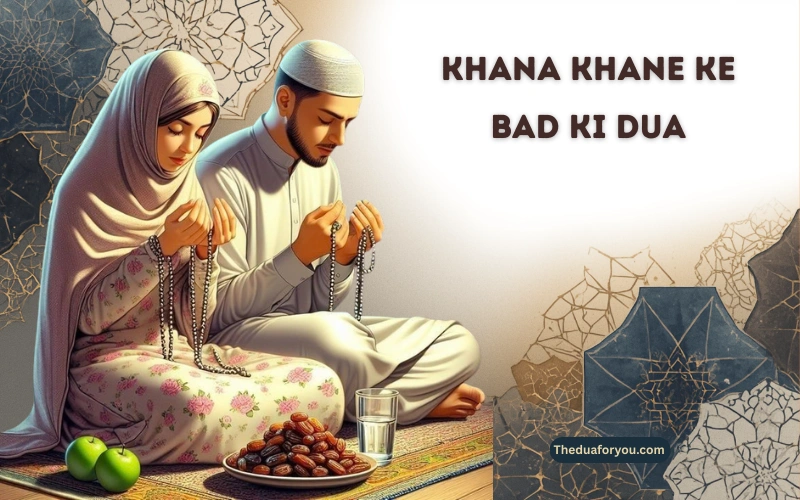
After every meal, a Muslim turns to Allah with gratitude. Khana khane ke bad ki dua is a short but deeply meaningful supplication that the Prophet Muhammad ﷺ taught his companions to recite after finishing food.
Food is one of the greatest blessings Allah has given us. Millions of people around the world go without a proper meal every single day. When we sit down and eat, acknowledging that blessing through a sincere dua is not just an Islamic act it is a mark of gratitude and character.
This dua is recorded in authentic hadith collections and is a confirmed Sunnah of the Prophet ﷺ. Reciting khana khane ke bad ki dua takes only a few seconds, but its spiritual value is immense. It connects a simple daily act eating to the remembrance of Allah.
Complete Khana Khane Ke Bad Ki Dua with Meaning
Khana Khane Ke Bad Ki Dua in Arabic
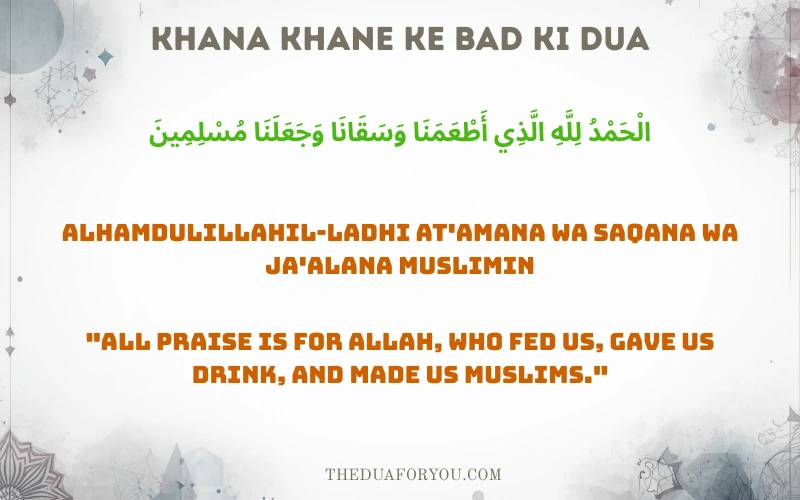
الْحَمْدُ لِلَّهِ الَّذِي أَطْعَمَنَا وَسَقَانَا وَجَعَلَنَا مُسْلِمِينَ
Transliteration
Alhamdulillahil-ladhi at’amana wa saqana wa ja’alana muslimin
Khana Khane Ke Bad Ki Dua Meaning in English
“All praise is for Allah, who fed us, gave us drink, and made us Muslims.”
This single sentence carries three expressions of gratitude for food, for water, and for the greatest blessing of all: Islam.
Khana Khane Ke Bad Ki Dua in Hindi
लहम्दुलिल्लाहिल्लज़ी अत’अमना व सक़ाना व जअलना मुस्लिमीन
“तमाम तारीफें अल्लाह के लिए हैं, जिसने हमें खाना खिलाया, पानी पिलाया और हमें मुसलमान बनाया।”
“Tamam tarifein Allah ke liye hain, jisne humein khaana khilaya, paani pilaya, aur hume musalman banaya.”
Khana khane ke bad ki dua in Hindi is easy to understand for Urdu and Hindi speaking Muslims. The meaning is clear, the words are simple, and the message is powerful — thank Allah after every meal.
Hadith Reference
This dua is narrated by Hazrat Abu Umamah (رضي الله عنه) and is recorded in:
- Sahih Muslim: Hadith No. 2734
- Sunan Abu Dawood: Hadith No. 3851
Both are among the most authentic hadith collections in Islam. The dua is authentically established and widely practiced by Muslims across the world.
Why This Khana Khane Ke Bad Ki Dua Is Important
When we eat a meal, we often take it for granted. We spend time planning what to eat, cooking, and sitting down but rarely pause to acknowledge who actually provided that food.
Allah says in the Quran (Surah Ibrahim: 7):
“If you are grateful, I will certainly give you more.”
Reciting khana khane ke bad ki dua is a direct act of shukr gratitude. It is also a reminder that the rizq (provision) we enjoy comes from Allah alone, not from our own efforts or plans.
The dua also includes the phrase “wa ja’alana muslimin”, “and made us Muslims.” This is significant. It is an acknowledgment that out of all the blessings, the greatest one is the blessing of faith. Including this in a post-meal supplication trains the heart to always remember the most important gift.
When to Read Khana Khane Ke Bad Ki Dua
The correct time to read this dua is immediately after finishing a meal whether it is breakfast, lunch, dinner, or any snack in between.
- Recite it as soon as you put down your utensil or finish the last bite.
- Say it in a calm and composed manner, not in a rush.
- It applies to every meal at home, at a restaurant, or anywhere else.
- If you forget to recite it right away, say it as soon as you remember.
There is no specific posture required. Whether you are sitting at a dining table or on the floor, the dua is valid and accepted.
Khana Khane Ke Bad Ki Dua for Kids
Teaching children Islamic duas from a young age is one of the most valuable gifts a parent can give. Khana khane ke bad ki dua for kids is especially important because it builds the habit of thanking Allah after eating a habit that stays with them for life.
Here is a simple way to teach this dua to children:
Step 1: Recite the dua slowly in front of your child after every meal.
Step 2: Break it into three small parts:
- Alhamdulillah – All praise to Allah
- alladhi at’amana wa saqana – who fed us and gave us drink
- wa ja’alana muslimin – and made us Muslims
Step 3: Explain the meaning in simple words. Tell them: “We are saying thank you to Allah because He gave us this food.”
Step 4: Encourage the child to repeat it after you. With a little daily practice, most children memorize it within a week.
Step 5: Praise them when they remember on their own. Positive reinforcement builds lasting habits.
Duas learned in childhood remain for a lifetime. Khana khane ke bad ki dua for kids is a beautiful and easy starting point for a child’s Islamic education.
Benefits of Khana Khane Ke Bad Ki Dua
1. Fulfilling a Sunnah of the Prophet ﷺ
The Prophet ﷺ recited this dua himself. Following his Sunnah in daily actions like eating is a form of worship that earns reward from Allah.
2. Expressing Gratitude to Allah
Gratitude is one of the highest virtues in Islam. This dua is a direct and sincere expression of shukr after receiving the blessing of food.
3. Barakah in Rizq
Scholars of Islam have noted that expressing gratitude for provision invites more barakah (blessing) into one’s sustenance. Allah’s promise in Surah Ibrahim supports this.
4. Acknowledging the Blessing of Islam
The line “wa ja’alana muslimin”, “and made us Muslims” is a reminder that being a Muslim is the greatest gift. Mentioning it after every meal keeps the heart attached to this truth.
5. Building a Habit of Dhikr
Reciting this dua after meals turns a routine daily activity into an act of worship. It is a small but consistent form of remembrance of Allah.
6. A Positive Mindset
Starting and ending meals with the remembrance of Allah brings a sense of peace, contentment, and thankfulness that positively shapes a Muslim’s overall attitude toward life.
Read Also: Khansi ki Dua
Dua Before Eating – A Quick Reminder
While this article focuses on khana khane ke bad ki dua, it is also Sunnah to say Bismillah before starting a meal.
بِسْمِ اللَّهِ “In the name of Allah.”
Together, saying Bismillah before eating and the full dua after eating, completes the Sunnah of mealtime in Islam.
Conclusion
Khana khane ke bad ki dua is a small act with a great reward. It takes just a few seconds to recite but carries within it a full acknowledgment of Allah’s blessings food, water, and faith.
Whether you are looking for khana khane ke bad ki dua in English, in Hindi, or in Arabic the words remain the same. The language of the heart is gratitude, and this dua is its expression.
Make it a habit after every meal. Teach it to your children. Share it with your family. And remember every bite of food you eat is a gift from Allah, and every time you say Alhamdulillah, you are honoring that gift.
May Allah accept our gratitude and bless us with more of His mercy and provision. Aameen.
? FAQs
Q: What is khana khane ke bad ki dua?
It is the dua recited after finishing a meal: “Alhamdulillahil-ladhi at’amana wa saqana wa ja’alana muslimin.”
Q: Is this dua from the Quran?
No, it is from the Hadith. It is recorded in Sahih Muslim (2734) and Sunan Abu Dawood (3851) — both highly authentic sources.
Q: What is khana khane ke bad ki dua in English?
The meaning in English is: “All praise is for Allah, who fed us, gave us drink, and made us Muslims.”
Q: Can children recite this dua?
Yes, absolutely. Khana khane ke bad ki dua for kids is one of the easiest duas to teach and should be introduced from a young age.
Q: What if I forget to say the dua after eating?
Say it as soon as you remember. Allah is Most Forgiving and Most Merciful. Try to build the habit so it becomes natural over time.
Q: Is this dua recited once or multiple times?
It is recited once after finishing the meal.
Q: Is there a different dua for after drinking water?
Yes, there is a separate dua for drinking water, though the post-meal dua covers both eating and drinking together.