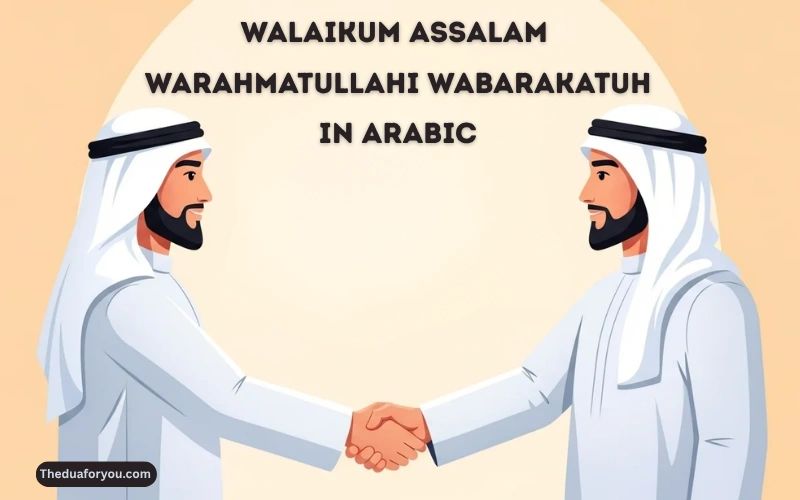
In Islam, the greeting of Salam is not just a polite exchange it is a prayer, a blessing, and an act of worship. Every time a Muslim says “Assalamu Alaikum Warahmatullahi Wabarakatuh” to another Muslim, they are sincerely asking Allah to bestow peace, mercy, and blessings upon that person.
The most complete, most rewarded, and most recommended reply to this greeting is:
وَعَلَيْكُمُ السَّلَامُ وَرَحْمَةُ اللهِ وَبَرَكَاتُهُ
Walaikum Assalam Warahmatullahi Wabarakatuh
This reply is not merely a social courtesy. It is a Sunnah of the Prophet Muhammad ﷺ, mentioned in the Quran, and backed by authentic Hadith. Those who give this full reply earn 30 good deeds (hasanat) in a single moment.
Whether you are meeting a fellow Muslim in person, replying on WhatsApp, or responding to an email this is the highest form of reply you can give.
Walaikum Assalam Warahmatullahi Wabarakatuh in Arabic
The correct Arabic text is:
وَعَلَيْكُمُ السَّلَامُ وَرَحْمَةُ اللهِ وَبَرَكَاتُهُ
This is the full and complete form. It is made up of three distinct parts, each carrying its own deep spiritual meaning:
| Arabic Part | Transliteration | Meaning |
|---|---|---|
| وَعَلَيْكُمُ السَّلَامُ | Wa Alaikumus Salaam | And upon you be peace |
| وَرَحْمَةُ اللهِ | Wa Rahmatullahi | And the mercy of Allah |
| وَبَرَكَاتُهُ | Wa Barakaatuh | And His blessings |
Each addition makes the reply more complete, more rewarding, and more spiritually powerful than the one before it.
Transliteration of Walaikum Assalam Warahmatullahi Wabarakatuh
For those learning to pronounce this reply correctly, the Roman transliteration is:
Wa Alaikumus Salaamu Wa Rahmatullaahi Wa Barakaatuh
“And upon you be peace, and the mercy of Allah, and His blessings.”
Pronunciation tips:
- Wa Alaikumus: Flow these words together smoothly. Do not pause between “Wa” and “Alaikumus.”
- Salaamu: Slightly elongate the “aa” sound: Salaa-mu, not Salam.
- Rahmatullaahi: The double “aa” in Ullaahi is elongated. The “h” at the end is soft and breathy.
- Barakaatuh: The “aa” is elongated: Barakaat. The final “h” is light almost silent mid-sentence, but gently audible when you pause.
Recite the entire phrase calmly and deliberately. This is a dua, not a casual expression. The words deserve to be said with awareness and care.
Walaikum Assalam Warahmatullahi Wabarakatuh in Urdu

In Urdu, this reply is written as:
وعلیکم السلام ورحمۃ اللہ وبرکاتہ
Its meaning in Urdu is:
“اور آپ پر بھی سلامتی ہو، اللہ کی رحمت ہو اور اس کی برکتیں ہوں۔”
(Aur aap par bhi salamati ho, Allah ki rehmat ho aur us ki barakaten hon.)
Urdu-speaking Muslims across Pakistan, India, and the global diaspora use this reply daily in conversation, text messages, and formal correspondence. Writing Walaikum Assalam Warahmatullahi Wabarakatuh in Urdu is equally rewarding as saying it verbally, according to Islamic scholars.
Walaikum Assalam Warahmatullahi Wabarakatuh in Hindi
In Hindi, the meaning of this reply is:
“और आप पर भी सलामती हो, अल्लाह की रहमत हो और उसकी बरकतें हों।”
(Aur aap par bhi salamati ho, Allah ki rehmat ho aur uski barakaten hon.)
The phrase Walaikum Assalam Warahmatullahi Wabarakatuh in Hindi is widely used by Muslim communities in India who want to understand or write this blessed reply correctly. Whether typed in Devanagari or understood in its translated form, the meaning and spiritual weight remain exactly the same.
Hadith Evidence: The Reward of 30 Good Deeds
The Prophet Muhammad ﷺ explicitly taught us the reward for each level of this greeting. Imran ibn Husain (رضي الله عنه) narrated:
“A man came to the Prophet ﷺ and said: ‘Assalamu Alaikum.’ The Prophet ﷺ returned the greeting and the man sat down. The Prophet ﷺ said: ‘Ten (good deeds).’ Then another man came and said: ‘Assalamu Alaikum Warahmatullah.’ The Prophet ﷺ returned the greeting and said: ‘Twenty.’ Then another came and said: ‘Assalamu Alaikum Warahmatullahi Wabarakatuh.’ The Prophet ﷺ returned the greeting and said: ‘Thirty.'” (Sunan Abu Dawood: 5195 | Jami’ At-Tirmidhi: 2689 — Hasan)
This Hadith is a direct and authentic proof that saying and replying with the full phrase Walaikum Assalam Warahmatullahi Wabarakatuh earns the maximum reward of 30 hasanat (good deeds) in a single exchange.
In another narration, the Prophet ﷺ said:
“Spread the Salam among yourselves.” (Sahih Muslim: 54)
This instruction emphasizes that Salam should not be limited to close friends it should be spread widely, to those you know and those you do not know.
The Three Levels of Salam Reply
Islam has defined three valid levels of response to Salam. Each is acceptable, but they differ in reward:
Level 1: The Minimum (Acceptable)
وَعَلَيْكُمُ السَّلَامُ
Wa Alaikumus Salaam
“And upon you be peace.”
This is the shortest acceptable reply. It fulfills the obligation but carries the least reward – 10 good deeds.
Level 2: The Better (Recommended)
وَعَلَيْكُمُ السَّلَامُ وَرَحْمَةُ اللهِ
Wa Alaikumus Salaamu Wa Rahmatullahi
“And upon you be peace and the mercy of Allah.”
This adds the prayer for Allah’s mercy. It earns 20 good deeds and is more virtuous than the minimum reply.
Level 3: The Most Complete (Most Virtuous)
وَعَلَيْكُمُ السَّلَامُ وَرَحْمَةُ اللهِ وَبَرَكَاتُهُ
Wa Alaikumus Salaamu Wa Rahmatullaahi Wa Barakaatuh
“And upon you be peace, the mercy of Allah, and His blessings.”
This is the Walaikum Assalam Warahmatullahi Wabarakatuh the complete, most rewarded, and most beautiful reply. It earns 30 good deeds and is the highest level of responding to the Islamic greeting.
When to Say Walaikum Assalam Warahmatullahi Wabarakatuh
1. When Someone Greets You with Salam
The most common occasion whenever a Muslim greets you with “Assalamu Alaikum” or its fuller forms, you respond with Walaikum Assalam Warahmatullahi Wabarakatuh. This is both a religious obligation and an act of worship.
2. When Entering the Home
Surah An-Nur (24:61) instructs Muslims to greet with Salam when entering homes. Those already inside should respond fully. This applies to your own home as well greeting your family when you walk in is a Sunnah that fills the house with blessings.
3. When Meeting Fellow Muslims
In the mosque, marketplace, school, or workplace any time you meet a Muslim, exchanging Salam and its full reply is highly encouraged. The Prophet ﷺ greeted children on the street, guests in his home, and companions in the mosque with equal warmth and sincerity.
4. When Parting or Saying Goodbye
Though most people associate Salam with greetings upon arrival, it is also Sunnah to say Salam when departing from a gathering or leaving someone’s company. The full reply applies equally in this situation.
5. In Written Communication: WhatsApp, Email, Letters
Islamic scholars agree that the ruling of Salam also applies to written greetings. If someone writes “Assalamu Alaikum Warahmatullahi Wabarakatuh” in a message or email, replying with Walaikum Assalam Warahmatullahi Wabarakatuh whether in Arabic, Urdu, or Hindi carries the same reward and fulfills the same obligation.
6. In Group Chats and Social Media
One person replying on behalf of a group is sufficient to lift the obligation from the rest. But if everyone replies individually, all of them earn the full reward. It is always better to reply than to leave a Salam unanswered.
Spiritual Benefits of Walaikum Assalam Warahmatullahi Wabarakatuh
1. Earns 30 Good Deeds in One Exchange
As established in the authentic Hadith of Sunan Abu Dawood and Tirmidhi, replying with the full phrase earns 30 hasanat. These are direct rewards recorded by the noble angels earned in a matter of seconds.
2. Increases Love and Brotherhood Among Muslims
The Prophet ﷺ said: “By the One in Whose Hand is my soul, you will not enter Paradise until you believe, and you will not believe until you love one another. Shall I not tell you of something that, if you do it, you will love one another? Spread the Salam among yourselves.” (Sahih Muslim: 54)
Saying and replying to Salam is one of the most effective and accessible ways to build genuine love and solidarity between Muslims.
3. A Living Reminder of Allah’s Name
As-Salam is one of the 99 Beautiful Names of Allah. Every time you say or reply with Salam, you are invoking one of Allah’s names. This is a constant, gentle reminder of the Divine that keeps the heart connected to Allah throughout even the busiest day.
4. A Reflection of Paradise
In the Quran, Allah describes how the angels will greet the believers in Jannah:
“And the angels will enter upon them from every gate, saying: ‘Salamun Alaikum for what you patiently endured. How excellent is the final home.'” (Surah Ar-Ra’d: 23-24)
Every time you exchange Salam in this world, you are practicing the greeting of Paradise itself.
5. Protection from Arrogance
Replying to Salam regardless of someone’s social status whether they are younger, poorer, less educated, or unknown to you is an act of sincere humility. The Prophet ﷺ always returned Salam, no matter who initiated it. This practice softens the heart and removes pride.
6. Repair and Restoration of Relationships
If there has been any tension or distance between two Muslims, exchanging the full Salam and its reply is one of the fastest ways to restore warmth and goodwill. It is difficult to harbor ill feelings toward someone for whom you are genuinely praying peace, mercy, and blessings.
Read Also: Barkat Ki Dua
Replying to Non-Muslims
A specific and important question arises: if a non-Muslim greets you with Salam, how do you reply?
The Prophet ﷺ addressed this directly:
“When the People of the Book greet you with Salam, say: ‘Wa Alaikum.'”
(Sahih Al-Bukhari: 6258 | Sahih Muslim: 2163)
The appropriate reply to a non-Muslim’s Salam is simply “Wa Alaikum” returning the greeting neutrally without the full extensions of Rahmatullah and Barakaatuh, which are specific Islamic prayers intended for a Muslim’s spiritual wellbeing.
Conclusion
Walaikum Assalam Warahmatullahi Wabarakatuh “وَعَلَيْكُمُ السَّلَامُ وَرَحْمَةُ اللهِ وَبَرَكَاتُهُ” is far more than a polite response. It is one of the most beautiful acts of worship a Muslim can perform dozens of times each day, without any special preparation or place.
In three short phrases, it encompasses the three greatest gifts a human being can receive: peace for the body, mercy for the soul, and blessings for all of life’s affairs.
The Quran commands it. The Prophet ﷺ practiced it. Authentic Hadith rewards it with 30 good deeds per exchange. And the angels of Paradise greet the believers with its essence in the eternal life to come.
Every time you say these words with awareness and sincerity whether in Arabic, Urdu, or Hindi you are making a genuine dua for your fellow Muslim, strengthening the bond of brotherhood and sisterhood, and placing a record of worship with Allah that no deed can erase.
Make it a habit. Say it completely. Say it sincerely. Say it every time.
? FAQs About Walaikum Assalam Warahmatullahi Wabarakatuh in Arabic
Q1. What is the correct Arabic text of Walaikum Assalam Warahmatullahi Wabarakatuh?
The correct Arabic is: وَعَلَيْكُمُ السَّلَامُ وَرَحْمَةُ اللهِ وَبَرَكَاتُهُ — with full diacritical marks (harakat) for precise pronunciation.
Q2. Is there a difference between “Alaikum Assalam” and “Walaikum Assalam”?
Scholars prefer “Walaikum Assalam” (with the letter Waw – “Wa” – at the start) because the “Wa” is the conjunction meaning “and,” which linguistically connects the reply back to the original greeting. This phrasing also appears in authenticated Hadith narrations and is more consistent with the Arabic grammar of the exchange.
Q3. How many good deeds do you earn for saying the full reply?
According to an authentic Hadith in Sunan Abu Dawood (5195) and Tirmidhi (2689), the full reply of Walaikum Assalam Warahmatullahi Wabarakatuh earns 30 good deeds the maximum possible reward for this greeting.
Q4. Is it obligatory to reply to Salam?
Yes. According to Quran 4:86 and the scholarly consensus (ijma’), replying to Salam is obligatory (wajib). If one person in a group replies, the obligation is lifted from the rest but each individual who replies personally earns their own full reward.
Q5. Can I write Walaikum Assalam Warahmatullahi Wabarakatuh in Urdu or Hindi?
Yes. Writing this reply in Urdu, Hindi, or any language carries the same obligation-fulfillment and reward. The key is sincerity and intention. The ruling applies equally to verbal, written, and digital communication.