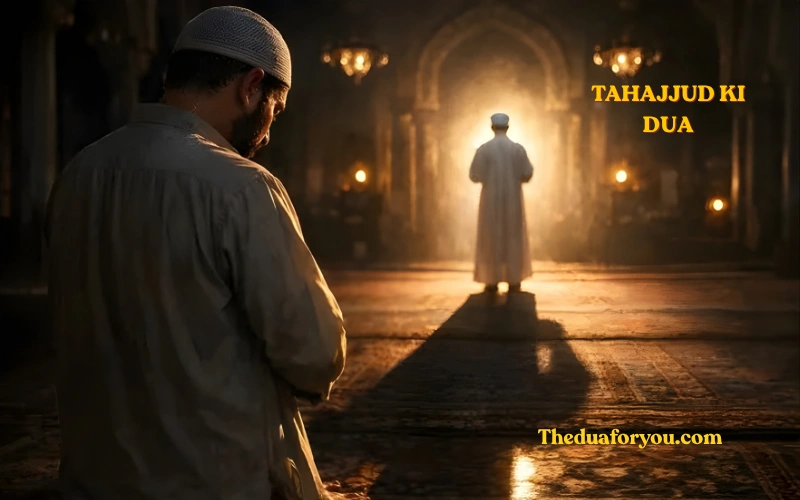
In the deep silence of the night, when the world is asleep, some people rise and stand before Allah in prayer. This night prayer is called Tahajjud, and the supplication made during this prayer is known as Tahajjud Ki Dua.
Tahajjud is a voluntary (Nafl) prayer performed after sleeping following Isha. It holds one of the highest positions among all voluntary acts of worship in Islam. The Prophet Muhammad ﷺ never missed this prayer throughout his life, and the Quran itself praises those who wake up at night to worship Allah.
The dua recited at the start of Tahajjud prayer is narrated in both Sahih Bukhari and Sahih Muslim, making it one of the most authentic supplications in the Sunnah.
Tahajjud Ki Dua in Arabic
This is the dua that the Prophet Muhammad ﷺ used to recite when he woke up for Tahajjud prayer. It is preserved in the most authentic books of Hadith.
Arabic Text:
اللَّهُمَّ لَكَ الْحَمْدُ أَنْتَ نُورُ السَّمَاوَاتِ وَالأَرْضِ وَمَنْ فِيهِنَّ، وَلَكَ الْحَمْدُ أَنْتَ قَيِّمُ السَّمَاوَاتِ وَالأَرْضِ وَمَنْ فِيهِنَّ، وَلَكَ الْحَمْدُ أَنْتَ الْحَقُّ وَوَعْدُكَ الْحَقُّ وَلِقَاؤُكَ حَقٌّ وَقَوْلُكَ حَقٌّ وَالْجَنَّةُ حَقٌّ وَالنَّارُ حَقٌّ وَالنَّبِيُّونَ حَقٌّ وَمُحَمَّدٌ حَقٌّ وَالسَّاعَةُ حَقٌّ، اللَّهُمَّ لَكَ أَسْلَمْتُ وَبِكَ آمَنْتُ وَعَلَيْكَ تَوَكَّلْتُ وَإِلَيْكَ أَنَبْتُ وَبِكَ خَاصَمْتُ وَإِلَيْكَ حَاكَمْتُ، فَاغْفِرْ لِي مَا قَدَّمْتُ وَمَا أَخَّرْتُ وَمَا أَسْرَرْتُ وَمَا أَعْلَنْتُ، أَنْتَ الْمُقَدِّمُ وَأَنْتَ الْمُؤَخِّرُ لَا إِلَهَ إِلَّا أَنْتَ
Tahajjud Ki Dua Transliteration
For those who are still learning Arabic, here is the Roman transliteration to help with pronunciation:
Allahumma lakal-hamdu anta noorus-samaawaati wal-ardi wa man feehinna. Wa lakal-hamdu anta qayyimus-samaawaati wal-ardi wa man feehinna. Wa lakal-hamdu antal-haqqu wa wa’dukal-haqqu wa liqaa’uka haqqun wa qawluka haqqun wal-jannatu haqqun wan-naaru haqqun wan-nabiyyoona haqqun wa Muhammadun haqqun was-saa’atu haqqun. Allahumma laka aslamtu wa bika aamantu wa ‘alayka tawakkaltu wa ilayka anabtu wa bika khasamtu wa ilayka haakamtu. Faghfir li maa qaddamtu wa maa akhkhartu wa maa asrartu wa maa a’lantu. Antal-muqaddimu wa antal-mu’akhkhiru laa ilaaha illaa ant.
Tahajjud Ki Dua in English – Meaning
O Allah, all praise is for You. You are the Light of the heavens and the earth and all that is within them. All praise is for You; You are the Sustainer of the heavens and the earth and all that is within them. All praise is for You; You are the Truth. Your promise is true, meeting You is true, Your word is true, Paradise is true, Hell is true, the Prophets are true, Muhammad ﷺ is true, and the Hour of Judgment is true.
O Allah, to You I have submitted, in You I have believed, upon You I have placed my trust, to You I have turned in repentance, with Your help I have opposed my enemies, and to You I refer for judgment.
So forgive me my past and future sins, what I have hidden and what I have made public. You are the One who brings forward and the One who puts back. There is no god worthy of worship except You.
Tahajjud Ki Dua in Urdu – Tarjuma
اے اللہ! تمام تعریفیں تیرے لیے ہیں۔ تو آسمانوں اور زمین اور ان میں جو کچھ ہے اس کا نور ہے۔ تمام تعریفیں تیرے لیے ہیں۔ تو آسمانوں اور زمین کو قائم رکھنے والا ہے۔ تمام تعریفیں تیرے لیے ہیں۔ تو حق ہے، تیرا وعدہ حق ہے، تیری ملاقات حق ہے، تیرا قول حق ہے، جنت حق ہے، جہنم حق ہے، نبی حق ہیں، محمد ﷺ حق ہیں، اور قیامت حق ہے۔ اے اللہ! میں نے تیرے آگے سر تسلیم خم کیا، تجھ پر ایمان لایا، تجھ پر بھروسہ کیا، تیری طرف رجوع کیا۔ پس میرے اگلے پچھلے، پوشیدہ اور ظاہر سب گناہوں کو معاف فرما دے۔ تو ہی آگے کرنے والا اور پیچھے کرنے والا ہے۔ تیرے سوا کوئی معبود نہیں۔
Tahajjud Ki Dua in Hindi – Tarjuma
ऐ अल्लाह! सारी तारीफें तेरे लिए हैं। तू आसमानों और ज़मीन और उनमें जो कुछ है, उसका नूर है। सारी तारीफें तेरे लिए हैं, तू आसमानों और ज़मीन को क़ायम रखने वाला है। सारी तारीफें तेरे लिए हैं। तू सच है, तेरा वादा सच है, तुझसे मिलना सच है, जन्नत सच है, जहन्नम सच है, नबी सच हैं, मुहम्मद ﷺ सच हैं और क़यामत सच है। ऐ अल्लाह! मैंने तेरे आगे सर झुका दिया, तुझ पर ईमान लाया, तुझ पर भरोसा किया। पस मेरे अगले-पिछले, छुपे और ज़ाहिर सब गुनाहों को माफ़ कर दे। तू ही आगे करने वाला और पीछे करने वाला है। तेरे सिवा कोई माबूद नहीं।
Explanation – Why This Dua Is So Special
Tahajjud Ki Dua is not just an opening supplication. It is a complete declaration of faith. Every sentence carries deep meaning and reflects the state of a believer standing before Allah in the stillness of the night.
The dua begins with the praise of Allah, acknowledging that He is the true Light of all creation. It then moves into a powerful affirmation of faith the believer confirms that Allah’s promise is true, that the Day of Judgment is true, that Paradise and Hell are real.
After this declaration, the believer turns fully to Allah submitting, trusting, repenting and then humbly asks for forgiveness of all sins, whether committed in the past or the future, whether hidden or visible.
This dua teaches us how to stand before Allah: with humility, awareness of His greatness, and complete reliance on His mercy. It sets the tone for the entire Tahajjud prayer that follows.
Disclaimer: The information provided on this page regarding Tahajjud Ki Dua is intended for general Islamic educational purposes only. All Arabic dua texts, translations, and references have been sourced from widely accepted and authentic Islamic literature, including Sahih Bukhari and Sahih Muslim.
Tahajjud Ki Dua Kab Padhna Chahiye – When to Read This Dua
Tahajjud Ki Dua Kab Padhna Chahiye is one of the most commonly asked questions. Here is the clear answer:
The Best Time:
The most recommended time for Tahajjud prayer and therefore this dua is the last third of the night, roughly one to two hours before the Fajr Adhan. This is based on the following hadith:
“Our Lord descends to the lowest heaven in the last third of every night and says: Who is supplicating to Me, that I may answer him? Who is asking of Me, that I may give him? Who is seeking My forgiveness, that I may forgive him?”
The Minimum Requirement:
If waking in the last third is difficult, it is still valid to pray Tahajjud at any point after Isha as long as you sleep first and then wake up to pray. Even two rakats are sufficient to receive the reward of Tahajjud.
This dua should be recited right after waking up and before beginning the prayer, or it can also be read as the opening supplication (Istiftah) of the Tahajjud prayer itself.
How to Perform Tahajjud Prayer – A Simple Method
Before reading the dua, here is a brief overview of how Tahajjud is performed:
Step 1 – Make the intention in your heart to pray Tahajjud. No specific verbal wording is required.
Step 2 – Perform Wudu (ablution) if needed.
Step 3 – Pray in sets of two rakats. The minimum is 2 rakats and the maximum commonly observed is 8 rakats, prayed in pairs (2+2+2+2). After every two rakats, give Salam and begin the next pair.
Step 4 – Recite Tahajjud Ki Dua after waking up or as the opening supplication.
Step 5 – Make personal dua. After the prayer, sit in humility and ask Allah for whatever is in your heart. This is the golden window for personal supplication.
Step 6 – End with Witr prayer if you have not already prayed it after Isha.
Tahajjud Ki Dua Ki Fazilat – Spiritual Benefits
The Tahajjud Ki Dua Ki Fazilat is mentioned in both the Quran and the authentic Sunnah. Below are the key spiritual benefits supported by reliable Islamic sources:
1. Forgiveness of All Sins
The dua itself is a request for complete forgiveness past, future, hidden, and public. When a Muslim recites this with sincerity and true repentance, it becomes a means of cleansing the heart from sins accumulated over time.
2. Allah’s Closeness at This Hour
The hadith in Sahih Muslim confirms that Allah is especially close to His servants in the last third of the night. When you recite Tahajjud Ki Dua at this hour, you are speaking directly to Allah at the moment He is most near.
3. The Highest Status in the Hereafter
Allah says in the Quran:
“And during the night, perform the Tahajjud prayer as an additional prayer for you. It may be that your Lord will raise you to a praised station (Maqam Mahmood).”
This verse directly connects the Tahajjud prayer to the highest rank in the Hereafter Maqam Mahmood.
4. Duas Are Accepted at This Time
The Prophet ﷺ said:
“There is an hour during the night in which no Muslim makes a dua to Allah for good in this world and the Hereafter, except that Allah grants it to him.”
Praying Tahajjud and making dua during this window is among the surest means of having one’s prayers answered.
5. Inner Peace and Strength
Those who regularly pray Tahajjud report a deep sense of calm, clarity of mind, and spiritual strength. This is not just a feeling it is the natural result of being close to Allah during the most private and sincere moments of worship.
6. A Mark of the Righteous
The Quran describes the people of Paradise as those who used to sleep little at night:
“They used to sleep but little of the night, and in the hours before dawn, they would seek forgiveness.”
Praying Tahajjud and reciting this dua places a believer among this blessed group.
Tips for Making Tahajjud a Regular Habit
Waking up at night for Tahajjud can feel difficult at first, but these practical steps can make it easier:
- Make the intention sincerely before sleeping. A firm intention is itself a form of worship, and Allah helps those who truly wish to worship Him.
- Set an alarm one to two hours before Fajr to make waking up easier in the beginning.
- Sleep with Wudu. The Prophet ﷺ recommended sleeping in a state of purity, which also prepares you for prayer if you wake up.
- Start small. Even two rakats of Tahajjud with this dua is enough to establish the habit. Do not overwhelm yourself at the start.
- Memorize the dua gradually. Break it into three parts and memorize one section at a time. Understanding the meaning as provided above makes memorization faster and the prayer more meaningful.
- Avoid overeating at night. A heavy stomach makes early rising very difficult.
Conclusion
Tahajjud Ki Dua is more than a recitation it is a conversation with Allah at the most peaceful and sincere hour of the night. It begins with the acknowledgment of Allah’s greatness, moves through a declaration of faith, and ends with a heartfelt plea for forgiveness.
The Prophet Muhammad ﷺ observed this prayer consistently throughout his life. The Quran honors those who rise at night in worship. And the hadith confirms that this is the hour when Allah Himself draws near to His servants, ready to answer, forgive, and bless.
Whoever makes Tahajjud and this dua a regular part of their life will notice a profound change not just in their spiritual state, but in their patience, clarity, and closeness to Allah in everyday life.
May Allah grant us all the ability to wake up for Tahajjud, recite this dua with sincerity, and be counted among those whom He loves. Ameen.
? Frequently Asked Questions
Q1: Is Tahajjud Ki Dua obligatory?
No, it is a Sunnah highly recommended but not obligatory.
Q2: Can this dua be read in languages other than Arabic?
The dua should be in Arabic. Personal supplications after prayer can be in any language.
Q3: How many rakats is Tahajjud prayer?
Minimum 2 rakats. The Prophet ﷺ commonly prayed 8 rakats, followed by 3 Witr.
Q4: Can women also pray Tahajjud and recite this dua?
Yes. It is for both men and women, performed at home during the same time.
Q5: What if I cannot wake up at the last third of the night?
Pray at any time after sleeping post-Isha. The reward is highest in the last third, but any time is valid.
Q6: Is there a difference between Tahajjud and Qiyam ul Layl?
Qiyam ul Layl is any voluntary night prayer. Tahajjud is specifically prayed after sleeping and then waking up.
Q7: What should I ask for after Tahajjud Ki Dua?
Anything forgiveness, health, guidance, or relief from hardship. This is one of the best times for personal supplication.
 Recite Also These Beautiful Duas For Blessings And Peace: