
Surah Takasur (Arabic: سورة التكاثر) addresses one of the deepest distractions of human life: the endless competition for more. It reveals how this pursuit diverts us from our true purpose and prepares us for accountability in the Hereafter. Named after its first word “At-Takasur” (the rivalry for increase), this Makki surah speaks directly to hearts caught in material values.
In an age of comparison culture and incessant competition wealth, status, followers, titles this surah’s message is deeply practical and spiritually urgent.
You’ll see how this surah reframes ambition, slows the anxious pace for possessions, and anchors life around meaningful purpose rather than hollow rivalry.
Surah Takasur Full
Arabic (Uthmāni Script)
بِسْمِ اللَّهِ الرَّحْمَٰنِ الرَّحِيمِ
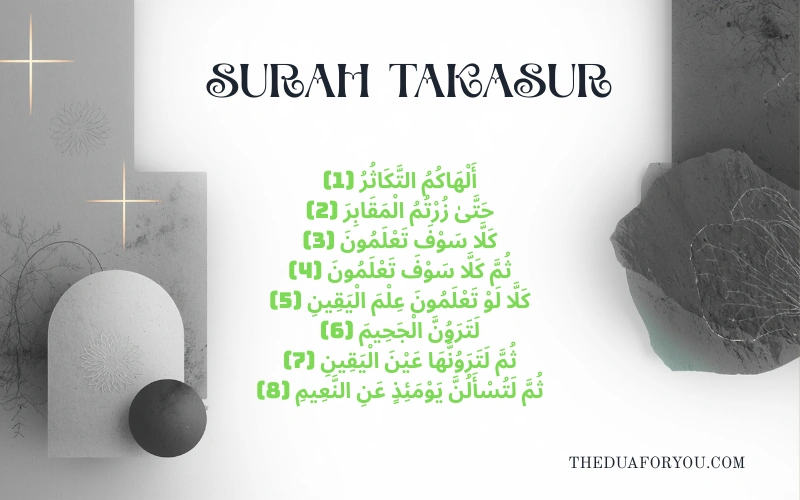
أَلْهَاكُمُ التَّكَاثُرُ (1)
حَتَّىٰ زُرْتُمُ الْمَقَابِرَ (2)
كَلَّا سَوْفَ تَعْلَمُونَ (3)
ثُمَّ كَلَّا سَوْفَ تَعْلَمُونَ (4)
كَلَّا لَوْ تَعْلَمُونَ عِلْمَ الْيَقِينِ (5)
لَتَرَوُنَّ الْجَحِيمَ (6)
ثُمَّ لَتَرَوُنَّهَا عَيْنَ الْيَقِينِ (7)
ثُمَّ لَتُسْأَلُنَّ يَوْمَئِذٍ عَنِ النَّعِيمِ (8)
Transliteration
Bismillāhir-Raḥmānir-Raḥīm
Alhākumu at-takāthur (1)
Ḥattā zurtumu al-maqābir (2)
Kallā sawfa taʿlamūn (3)
Thumma kallā sawfa taʿlamūn (4)
Kallā law taʿlamūna ʿilma al-yaqīn (5)
Latarawunna al-jaḥīm (6)
Thumma latarawunnahā ʿayna al-yaqīn (7)
Thumma latus’alunna yawma’idhin ʿani an-naʿīm (8)
English Meaning
-
Rivalry for worldly increase has distracted you.
-
Until you visit the graves.
-
No! You will surely know.
-
Then no! You will surely know.
-
No! If you only knew with certainty.
-
You will surely see Hellfire.
-
Then you will surely see it with the eye of certainty.
-
Then you will surely be asked that Day about the blessings.
Surah Takasur with Urdu Translation
یہ آپس کی دوڑ اور بڑھاپے کی خواہش آپ کو غافل کر دیتی ہے، یہاں تک کہ تم قبروں تک پہنچتے ہو۔ ہرگز نہیں، عنقریب تم جان لو گے۔ پھر ہرگز نہیں، عنقریب تم جان لو گے۔ اگر تم یقین کے علم سے جانتے تو یقیناً جہنم کو دیکھتے۔ پھر تم اسے عین الیقین سے دیکھو گے۔ پھر اس دن تم سے نعمتوں کے بارے میں پوچھا جائے گا۔
Context & Tafsir What Scholars Say
What “Takasur” Truly Means
The term Takāthur comes from the root kathrah and conveys mutual competition to amass and boast about more of everything not just wealth but also children, status, and influence. The distraction is so consuming that it blinds the heart to higher purposes, especially preparation for the Hereafter.
Historical & Theological Background
-
The surah is Makki revealed in Makkah focusing on moral reform and spiritual awakening.
-
It uses direct address and repetition to interrupt complacency and confront human distraction explicitly.
-
Classical tafsir explains Takāthur as obsession with worldly accumulation to the point of neglecting spiritual duties and the reality of death and judgment.
Why Repetition Matters
The repeated phrase “Kallā sawfa taʿlamūn” reinforces that the ultimate truth of accountability and the unseen world will become evident, especially when one confronts death. Scholars correlate this structure with progressive realization: intellectual awareness first, then reality, and finally direct witnessing with certainty.
Practical Reflection & Life Application
1. Reframing Ambition
Surah Takasur doesn’t forbid success or lawful ambition but calls out unhealthy competition where self-worth is tied to having more. Recognizing this difference transforms work from hollow accumulation to meaningful contribution and service.
2. Prioritizing Accountability
The closing verse reminds believers that every blessing including those often taken for granted will be examined. Gratitude becomes a daily practice rather than a seasonal thought.
3. Scaling Back Anxiety
By confronting the inevitability of death and the futility of endless rivalry, this surah can actually offer emotional balance and deeper contentment in life.
Surah Takasur Benefits
Spiritual & Psychological Benefits
-
Detaches from unhealthy comparison.
-
Encourages gratitude and mindfulness.
-
Strengthens ethical decision-making.
-
Counters anxiety rooted in material pursuit.
Read Also: Ayatul Kursi Dua
Surah Takasur 7-Day Memorization & Deep Reflection Plan
Who This Plan Is For
-
Those who want accurate memorization with correct flow
-
Readers seeking meaningful engagement, not mechanical repetition
-
Teachers who want a class-ready framework
-
Anyone aiming to internalize the message of Surah Takasur in daily life
How to Use This Plan (Important)
-
Memorization always comes before reflection
-
Recite slowly and audibly
-
Read the meaning after memorization, not before
-
Keep reflections short and honest, not philosophical
Day 1 Orientation & Intention
Task
-
Read the full Surah once from the Mushaf
-
Listen to a slow, verified recitation once
-
Set intention: “This Surah will correct my priorities.”
Reflection Focus
-
Where does competition affect your peace today?
-
What “more” do you secretly chase?
Key Insight: Takasur begins in the heart before it appears in actions.
Day 2 Verse 1 Memorization
Verse
أَلْهَاكُمُ التَّكَاثُرُ
Alhākumu at-takāthur
Memorization Tip
-
Break into two sounds: Al-hā-ku-mu / at-ta-kā-thur
-
Repeat 10 times slowly, 5 times without looking
Reflection
-
What distracts you most: wealth, status, validation, comparison?
Core Meaning: Distraction is the danger not possession.
Day 3 Verse 2 Memorization
Verse
حَتَّىٰ زُرْتُمُ الْمَقَابِرَ
Ḥattā zurtumu al-maqābir
Memorization Tip
-
Emphasize ḥattā (until)
-
Pause slightly before al-maqābir
Reflection
-
If competition ends only at the grave, what was it worth?
Reality Check: Death does not argue it interrupts.
Day 4 Verses 3 & 4 Memorization
Verses
كَلَّا سَوْفَ تَعْلَمُونَ
ثُمَّ كَلَّا سَوْفَ تَعْلَمُونَ
Memorization Tip
-
Memorize as a paired warning
-
Focus on rhythm and repetition
Reflection
-
Why does Allah repeat this warning?
-
What truth do people delay accepting?
Lesson: Some knowledge comes only after loss unless we reflect early.
Day 5 Verse 5 Memorization
Verse
كَلَّا لَوْ تَعْلَمُونَ عِلْمَ الْيَقِينِ
Memorization Tip
-
Hold a clear pause after kallā
-
Stress ʿilm al-yaqīn
Reflection
-
What do you “know” but don’t live by?
-
Where is your certainty weak?
Concept: Knowledge without certainty does not transform behavior.
Day 6 Verses 6 & 7 Memorization
Verses
لَتَرَوُنَّ الْجَحِيمَ
ثُمَّ لَتَرَوُنَّهَا عَيْنَ الْيَقِينِ
Memorization Tip
-
Emphasize la-ta-ra-wun-na
-
Recite with seriousness, not speed
Reflection
-
What would change today if outcomes were visible now?
Truth: Seeing replaces all excuses.
Day 7 Verse 8 Memorization & Full Review
Verse
ثُمَّ لَتُسْأَلُنَّ يَوْمَئِذٍ عَنِ النَّعِيمِ
Memorization Tip
-
Practice linking this verse to verse 7 smoothly
-
Recite entire Surah without pause
Reflection
-
List 5 blessings you rarely think about
-
For each, ask: How do I use this responsibly?
Final Accountability: Blessings are not owned they are entrusted.
Weekly Review Practice (After Completion)
Once Per Week
-
Recite Surah Takasur from memory
-
Ask one question only: “What distracted me this week?”
Monthly
-
Re-read the Urdu translation
-
Adjust one habit that feeds unhealthy competition
Common Memorization Mistakes (Avoid These)
-
Rushing through verses
-
Ignoring meaning completely
-
Treating repetition as boredom
-
Memorizing without revising older verses
Outcome of This Plan
By the end of this process, you will:
-
Recite Surah Takasur accurately and confidently
-
Grasp its moral architecture
-
Feel a shift in how you view success
-
Recognize blessings as responsibility, not entitlement
Conclusion: A Lifelong Reminder, Not a One-Time Read
Surah Takasur is both a mirror and a compass. It reflects the human condition often distracted by worldly ambitions and offers direction toward purposeful living and preparation for what truly awaits after death. Its power lies not just in recitation, but in internalizing its message and letting it shape a life anchored in gratitude, mindful living, and ethical success.
Reflect on these verses daily. Let them temper your competition with contentment and accountability.
? Frequently Asked Questions
1. What does Takasur mean?
It refers to mutual competition for increase specifically worldly gains, power, status, and pride that distract from spiritual accountability.
2. Why is this short surah so important?
Despite only eight verses, scholars report traditions highlighting its spiritual weight and warning against heedlessness.
3. Does it forbid earning wealth?
No, it cautions against competition that blinds one to purpose. Ethical effort and lawful earning remain encouraged.
4. When was it revealed?
It’s Makki, revealed early in the Prophet’s mission while the community was forming its ethical foundations.
5. How does it relate to modern life?
In a world driven by metrics followers, wealth, titles its message is especially relevant: meaning matters more than numbers.