Surah Kafiroon (Chapter 109) is a powerful Makki surah revealed to Prophet Muhammad (PBUH) during intense persecution. It establishes absolute clarity about Islamic monotheism, rejecting all forms of compromise in worship. This surah contains 6 verses, teaches Muslims to respect religious boundaries while maintaining firm principles, and offers immense spiritual protection when recited regularly.
The chapter’s brevity masks its profound depth. Each verse builds a wall of theological clarity, leaving no room for the syncretism that the polytheists proposed. Yet the final verse offers a framework for peaceful coexistence a balance that modern Muslims still navigate in pluralistic societies.
What makes this surah particularly significant is its dual function? it served as a decisive response to a specific historical challenge while establishing timeless principles for Muslim identity. The following comprehensive treatment covers everything you need from perfect recitation to practical application.
Reading Time: 7 minutes
Best For: Muslims seeking Genuine understanding of this powerful Makki surah and its application in daily worship.
| Category | Details |
|---|---|
| Surah Name | Al-Kafiroon (الكافرون) |
| Meaning | The Disbelievers |
| Surah Number | 109 |
| Total Verses | 6 |
| Total Words | 26 |
| Total Letters | 95 |
| Revelation Place | Makkah (Makki) |
| Revelation Period | Early Makkan Period (7th year of Prophethood) |
| Position in Quran | Juz 30, Para 30 |
| Theme | Rejection of Polytheism & Religious Clarity |
| Alternative Names | Surah Al-Kafirun, Surah Qul Ya Ayyuhal Kafirun |
| Recitation Time | Approximately 30-40 seconds |
| Recommended Times | Before sleep, Witr prayer, 2 Rak’ah before Fajr |
| Reward | Equivalent to one-quarter of the Quran (Hadith) |
| Key Message | No compromise in worship of Allah |
Surah Kafiroon with Urdu Translation With Arabic Text
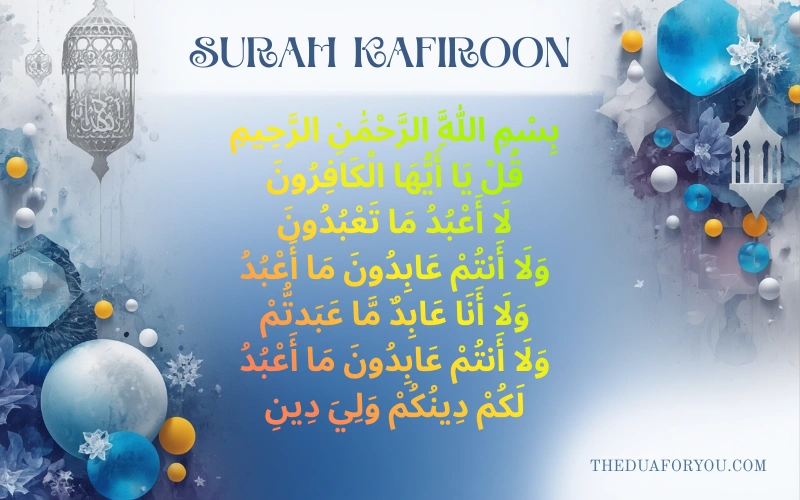
Arabic: بِسْمِ اللَّهِ الرَّحْمَٰنِ الرَّحِيمِ
Urdu: شروع اللہ کے نام سے جو بڑا مہربان نہایت رحم والا ہے
Arabic: قُلْ يَا أَيُّهَا الْكَافِرُونَ
Urdu: کہہ دیجیے: اے کافرو!
Arabic: لَا أَعْبُدُ مَا تَعْبُدُونَ
Urdu: میں ان کی عبادت نہیں کرتا جن کی تم عبادت کرتے ہو۔
Arabic: وَلَا أَنتُمْ عَابِدُونَ مَا أَعْبُدُ
Urdu: اور نہ تم اس کی عبادت کرنے والے ہو جس کی میں عبادت کرتا ہوں۔
Arabic: وَلَا أَنَا عَابِدٌ مَّا عَبَدتُّمْ
Urdu: اور نہ میں ان کی عبادت کرنے والا ہوں جن کی تم عبادت کرتے رہے۔
Arabic: وَلَا أَنتُمْ عَابِدُونَ مَا أَعْبُدُ
Urdu: اور نہ تم اس کی عبادت کرنے والے ہو جس کی میں عبادت کرتا ہوں۔
Arabic: لَكُمْ دِينُكُمْ وَلِيَ دِينِ
Urdu: تمہارے لیے تمہارا دین ہے اور میرے لیے میرا دین۔
Surah Kafiroon English Transliteration
Verse 1: Qul yaa ayyuhal kaafiroon
Verse 2: Laa a’budu maa ta’budoon
Verse 3: Wa laa antum ‘aabidoona maa a’bud
Verse 4: Wa laa ana ‘aabidun maa ‘abadtum
Verse 5: Wa laa antum ‘aabidoona maa a’bud
Verse 6: Lakum deenukum wa liya deen
Surah Kafiroon in English: Detailed Translation
The English rendering captures both literal accuracy and intended meaning:
Verse 1: “Say, ‘O you who disbelieve,'”
The direct address commands Prophet Muhammad (PBUH) to speak clearly to those rejecting faith.
Verse 2: “I do not worship what you worship.”
Present tense establishes current rejection of polytheistic practices.
Verse 3: “Nor are you worshippers of what I worship.”
Acknowledges the polytheists’ present state of rejecting pure monotheism.
Verse 4: “Nor will I be a worshipper of what you worship.”
Future tense eliminates any possibility of compromise.
Verse 5: “Nor will you be worshippers of what I worship.”
Recognizes that the hardened disbelievers will not accept truth.
Verse 6: “For you is your religion, and for me is my religion.”
Establishes mutual recognition without theological mixing.
Read Also: Surah Maun 7 Times
Historical Context: The Revelation Moment
Surah e kafiroon descended in Makkah during the seventh year of prophethood, when persecution against Muslims intensified. The Quraysh leadership including figures like Al-Waleed ibn Al-Mughirah approached the Prophet with what seemed like a political solution.
Their proposal: alternate worship between Allah and their idols (Al-Lat, Al-Uzza, and Manat) on a yearly or six-month basis. This wasn’t mere tolerance it was an attempt to dilute tawheed (Islamic monotheism) into a hybrid system.
The response was immediate and uncompromising. These six verses established that worship cannot be negotiated, divided, or compartmentalized. The surah addresses a specific audience (“those disbelievers” who proposed the compromise) while setting a universal principle.
Why the Repetition Matters
Verses 2-5 appear repetitive at first glance, but classical scholars identified distinct purposes:
Verses 2 & 3 address the present state the current incompatibility between Islamic worship and polytheistic practices.
Verses 4 & 5 address the future state eliminating any hope that Muslims might eventually compromise or that the hardened disbelievers would genuinely convert.
This fourfold structure creates rhetorical emphasis while closing every potential loophole the Quraysh might exploit. It’s not redundancy it’s comprehensive clarity.
Spiritual Benefits Supported by Hadith
Protection from Shirk (Polytheism): The Prophet (PBUH) said: “Whoever recites Surah Al-Kafiroon, it will be equivalent to reciting a quarter of the Quran.” (Tirmidhi)
Bedtime Recitation: Prophet Muhammad (PBUH) regularly recited surah kafiroon before sleep. Scholars explain this protected him from doubts and ensured he died in a state of pure faith.
Witr Prayer: The Prophet recited this surah in the final unit of Witr prayer, teaching Muslims to end their day with clarity about tawheed.
Warning: These benefits require sincere intention and understanding mechanical recitation without reflection provides limited spiritual value.
Practical Application in Modern Life
Daily Recitation Schedule:
- After Maghrib prayer (as the Prophet did)
- Before sleep (authenticated sunnah)
- During times of ideological confusion or pressure to compromise faith
Teaching Children: This surah’s brevity makes it perfect for young Muslims. The clear message helps them develop strong Islamic identity early.
Interfaith Contexts: Verse 6 (“For you is your religion, and for me is my religion”) is often cited regarding religious pluralism. However, scholars emphasize this verse establishes respect without theological compromise a distinction critical in contemporary discourse.
Trade-off to Consider: Some Muslims struggle between the surah’s uncompromising message and modern pressure for religious relativism. The authentic position maintains respect for others while never diluting Islamic theology.
Common Recitation Mistakes to Avoid
Pronunciation Errors:
- “Kaafiroon” not “Kaferoon” (proper emphasis on the ‘aa’)
- “A’budu” requires clear ‘ayn sound at the beginning
- “Deenukum” versus “Deenakum” (u-sound, not a-sound)
Tajweed Rules:
- Qalqalah (echoing sound) on the letter ‘qaf’ in multiple instances
- Ghunnah (nasal sound) when noon and meem have shaddah
- Proper pause at verse endings (required stops marked in Quran)
Conceptual Misunderstanding: The final verse doesn’t endorse religious relativism (“all paths are equal”). It establishes peaceful coexistence while maintaining that only Islam represents truth. This nuance matters in both personal understanding and public discussion.
Scholarly Insights from Classical Exegesis
Ibn Kathir’s Tafsir emphasizes that the surah’s audience was specific disbelievers who proposed the compromise, not all non-Muslims. This precision prevents misapplication.
Imam Qurtubi highlighted the grammatical shift between present and future tenses, showing the surah addresses both current practice and permanent principle.
Modern scholars (2025-2026 conferences on Quranic application) stress that while the surah’s message is absolute regarding worship, it doesn’t prohibit normal social interaction, business dealings, or civil cooperation with non-Muslims distinctions sometimes blurred in popular understanding.
Conclusion
Surah Kafiroon delivers a message as relevant today as it was 1,400 years ago faith requires clarity, not compromise. In an era of increasing religious pluralism and pressure to soften distinctive beliefs, these six verses remind Muslims that respecting others’ choices doesn’t mean diluting one’s own convictions.
The surah’s genius lies in its balance uncompromising theological purity combined with acknowledgment of free will and peaceful coexistence. This framework allows Muslims to maintain strong Islamic identity while functioning as positive contributors to diverse societies.
Whether you’re memorizing it for daily prayers, teaching children their first surahs, or seeking deeper understanding of Islamic theology, the time invested in truly grasping surah kafiroon with Urdu translation or English meaning pays eternal dividends. Its brevity makes memorization simple; its depth makes contemplation endless.
The Prophet Muhammad (peace be upon him) chose this particular surah for his final prayers before sleep and for concluding the night prayer. Following this authenticated practice connects you to a 1,400-year chain of believers who found strength, clarity, and protection in these powerful verses.
? FAQs About Surah Kafiroon
Q1: Why is Surah Kafiroon called one-quarter of the Quran?
The Quran addresses four major themes tawheed (monotheism), legislation, promises, and stories. This surah comprehensively addresses freedom from shirk (polytheism), representing one of these four pillars. The hadith categorization refers to thematic weight, not literal word count.
Q2: Can I recite this surah in every prayer?
Yes, though varying your recitation is better. The Prophet specifically recited it in Witr and sometimes in the two rak’ahs before Fajr. Regular variation prevents mechanical recitation and maintains focus.
Q3: Does verse 6 mean all religions are equally valid?
No. The verse establishes mutual recognition and the right to practice one’s faith without compulsion, but doesn’t validate theological equality. Islam maintains it is the final, complete truth while respecting others’ free will to choose differently.
Q4: How should I recite surah al kafiroon if I’m still learning Arabic?
Start with transliteration, gradually memorizing Arabic pronunciation. Use audio from qualified reciters (Mishary Rashid Alafasy or Abdul Basit recommended). Perfect pronunciation matters in formal prayer, so invest time in learning proper tajweed rules.
Q5: What’s the difference between this and Surah Al-Ikhlas?
Surah Kafiroon negatively defines faith (rejecting false worship), while Surah Al-Ikhlas positively defines it (affirming Allah’s unique attributes). Both are essential, complementary perspectives on tawheed.