
You can have the best product in the world and the most expensive ad campaign driving traffic to it, but if your website is difficult to use, you will fail. In the digital economy, your website’s design isn’t just “decoration”—it is your silent salesperson.
User Experience (UX) and User Interface (UI) design have moved from being “nice-to-haves” to being critical business survival skills. In 2026, a website needs to do more than just look good; it needs to intuitive, accessible, and designed for conversion. Here is why investing in professional UX is the highest ROI activity you can undertake.
1. The 50-Millisecond Judgment
Research shows that it takes about 0.05 seconds for a user to form an opinion about your website. In that blink of an eye, they decide whether to stay or leave. This “bounce” isn’t logical; it’s emotional.
If your layout looks cluttered, your fonts are hard to read, or your color scheme screams “amateur,” trust is instantly broken. Professional UI design establishes immediate credibility. It signals to the visitor that you are an established authority, making them far more likely to pull out their credit card later in the journey.
2. Reducing Friction in the Funnel
The goal of UX design is to remove obstacles. Every extra click, every confusing menu item, and every slow-loading image is “friction.” Friction kills sales.
Think of your website as a physical store. If the aisles are messy and the checkout counter is hidden, customers will walk out. A well-designed User Journey maps out exactly where you want the visitor to go. As established by the Nielsen Norman Group’s usability heuristics, good design prevents errors and gives users freedom and control, guiding them effortlessly from “Landing Page” to “Thank You Page.”
3. Design for Thumbs, Not Just Mice
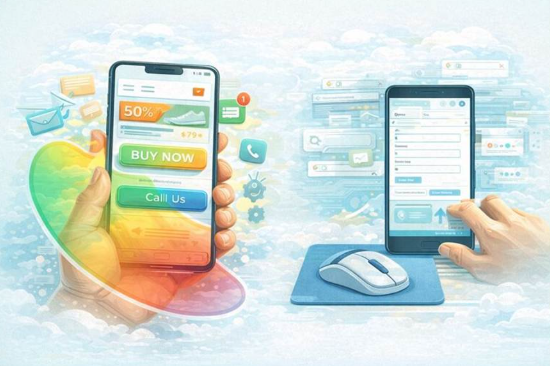
We have touched on mobile-first indexing for SEO, but mobile design is a different beast. Mobile users behave differently. They are impatient, they are often distracted, and they are navigating with clumsy thumbs.
Good mobile UX places key elements (like “Buy Now” or “Call Us”) within the “thumb zone”—the area of the screen easily reachable with one hand. It avoids tiny links that are hard to tap and ensures forms are easy to fill out without zooming. If your mobile experience feels like a shrunken desktop site, you are alienating half your audience.
The ROI of Empathy
Ultimately, good design is about empathy. It is about understanding your customer’s frustration and solving it before they even feel it. Companies that prioritize design outperform their competitors because they make it easy to do business with them.
If you are interested in learning more about how design principles intersect with marketing success, or want to read about the latest trends in digital development, you can explore the resources at MeraSEO. Understanding the psychology behind the click is key to mastering the digital space.
Conclusion
Don’t treat web design as a one-time expense to get out of the way. Treat it as an investment in your customer’s happiness. When you respect your user’s time and attention through clean, functional design, they reward you with their loyalty.