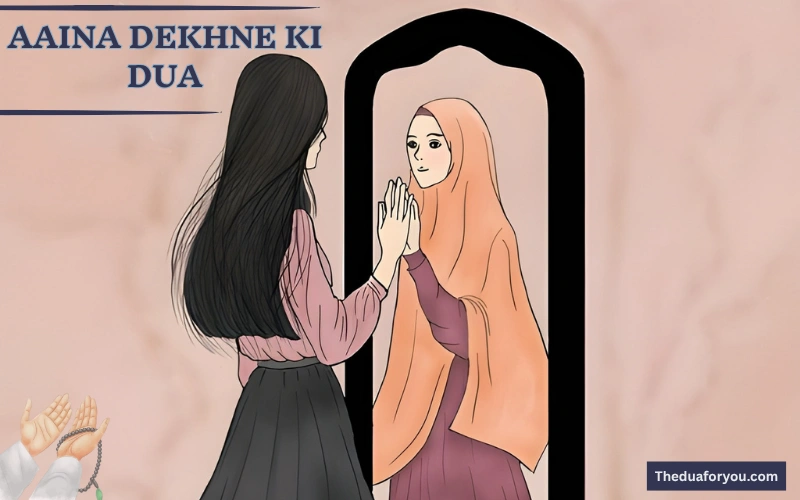
The Aaina Dekhne Ki Dua holds a special place among the daily supplications in Islam. When a believer looks into a mirror, it becomes an opportunity to remember Allah, express gratitude, and ask for both outer and inner beauty. This dua beautifully connects physical appearance with moral character, reminding us that true beauty lies not in what is seen, but in the values we live by.
Rooted in authentic Islamic teachings, the Aaina Dekhne Ki Dua in Hindi and Urdu helps Muslims begin their day with humility and self-awareness. It reflects the Prophet Muhammad ﷺ’s emphasis on good manners and noble character, guiding every Muslim to seek refinement of the soul alongside the blessings of appearance.
What is “Aaina Dekhne Ki Dua”?
Meaning of the phrase: “Aaina dekhne ki dua” (آئینہ دیکھنے کی دعا) literally means “the supplication to be said when seeing the mirror.” Similarly “mirror dekhne ki dua,” “sheesha dekhne ki dua,” or “aina dekhnay ki dua” are expressions used in Urdu or Hindi contexts.
Aaina Dekhne Ki Dua With Tarjuma: The version commonly recited is:
-
Arabic:
اللَّهُمَّ أَنْتَ حَسَّنْتَ خَلْقِي فَحَسِّنْ خُلُقِي
-
Transliteration:
Allahumma anta hassanta khalqi fa hassin khuluqi -
Translation (English):
“O Allah, just as You have made my physical creation good, make my character good (also).”
-
Urdu Translation:
“اے اللہ تو نے میری شکل اچھی بنائی ہے، پس میرے اخلاق بھی اچھے کر دے”
-
Hindi Translation:
“हे अल्लाह, जैसे तूने मेरी सूरत अच्छी बनाई है, वैसे ही मेरे चरित्र को भी सुंदर बना दे।”
Authenticity and Scholarly Opinions
This is a crucial part: Is this dua authentically from Prophet Muhammad ﷺ, specifically tied to looking into a mirror, or is it a later attribution?
-
Scholars note that the dua itself (اللَّهُمَّ أَنْتَ حَسَّنْتَ خَلْقِي فَحَسِّنْ خُلُقِي) is found in several collections such as Musnad Ahmad and Sahih Ibn Hibban. Some scholars consider the dua text sahih (authentic) in those collections.
-
However, the specific attribution—that this dua was recited when looking in a mirror—has weak chains of narration. There is no strong hadith in the major books that clearly states “Prophet ﷺ looked in the mirror and said this dua.” Scholars have assessed that the link (when used specifically for mirror) is weak or fabricated.
-
Thus, many scholars advise caution: the dua itself is acceptable, but declaring it a sunnah specifically tied to mirrors is not firmly established.
How to Use It / When to Recite
Since the specific link to mirrors is weak, one should understand how to use this dua properly:
-
You may recite it when you see your reflection, or any time you appreciate your physical appearance and wish for better character—since the meaning is broader.
-
It should be recited with sincerity, humility, and awareness that external beauty without good character is incomplete.
Related Duas
While aaina dekhne ki dua is focused on asking for beauty of character, there are other duas in Islam related to appearance, gratitude, self-improvement, and inner good. Here are a few:
-
Dua of gratitude — For Allah’s blessings:
Alhamdu lillahi alladhi ahyana baʿda ma amatana wa ilayhi nushoor
(Praise be to Allah who has given us life after He caused us to die and to Him is the return.) -
Dua for good character — Prophet ﷺ said character is the best. For example:
Rabbi habli hukman wa alhiqni bis-salihina
(O my Lord, grant me wisdom and join me with the righteous.) -
Dua for beauty and protection from evil eye — Some make dua:
Aʿūdhu bi-kalimatillāhi-t-tāmmāti min sharri mā khalaq
(I seek refuge in the perfect words of Allah from the evil of what He has created.)
These duas are more general but align with the spirit of being thankful for one’s appearance and asking for inner betterment.
Read Also: Full Namaz e Janaza Ki Dua
Tips for Using This Dua Meaningfully
-
Always have correct intention: gratitude, humility, desire to improve character.
-
Use it not only when looking at mirror, but whenever you feel pride in appearance, so that character matches.
-
Do dhikr (remembrance of Allah), recite regular duas for good character, follow Sunnah regarding manners.
-
Avoid excessive focus on outward looks; Islam encourages balance: outer beauty is blessing, inner beauty is more lasting.
Conclusion
The message of the Aaina Dekhne Ki Dua goes far beyond the act of looking into a mirror. It is a reflection of gratitude, modesty, and spiritual awareness. This simple supplication serves as a reminder that beauty is complete only when it is accompanied by good character.
By reciting Aaina Dekhne Ki Dua with tarjuma, one not only acknowledges Allah’s blessings but also seeks His help in developing inner grace and humility. It encourages believers to value good manners, sincerity, and kindness as the true adornments of faith. In essence, this dua is a mirror of self-improvement — a prayer for a heart as beautiful as the face it reflects.
May Allah grant us good character, humility, and sincerity in all our acts. Amin.
? FAQs (Frequently Asked Questions)
| QUESTION | ANSWER |
|---|---|
| Is aaina dekhne ki dua sahih? | The wording of the dua اللَّهُمَّ أَنْتَ حَسَّنْتَ خَلْقِي فَحَسِّنْ خُلُقِي is considered authentic in certain hadith collections. But saying it specifically when looking in a mirror is not conclusively proven. |
| Can I recite this dua every time I look in mirror? | Yes, if you do so with sincerity. Since the dua is acceptable, using it as a reflection to improve one’s character is beneficial. |
| Must we recite it in Arabic or can we translate? | Best practice is to recite authentic duas in Arabic. But understanding the meaning (in Urdu, Hindi, etc.) is important. One may also make dua in one’s own language for what is good. |
| Are there directions/prayers in Quran about outward and inward beauty? | The Quran emphasizes good character (khuluq) repeatedly, and outer appearance too in terms of modesty and gratitude. But there is no specific Qur’anic verse tied as “mirror dua.” |
| Is it bid‘ah (an innovation) to attribute this dua specifically to mirror-use? | Scholars generally caution: attributing specific acts to the Prophet ﷺ without strong evidence can amount to unwanted innovation in religious practice. Using the dua generally is okay; insisting it is a sunnah tied to mirrors alone is not assured. |