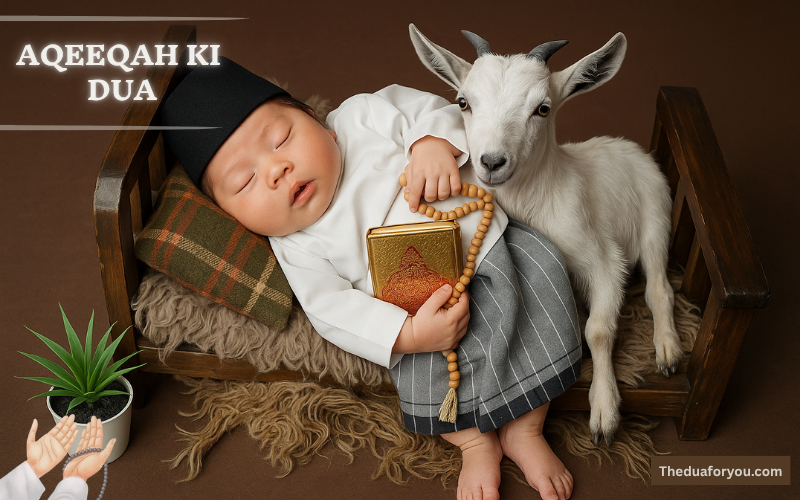
When a blessed newborn arrives, the practice of performing the Aqeeqah becomes a beautiful way of expressing gratitude to Allah and seeking protection for the child.
Here we focus on the aqeeqah ki dua – the specific supplication recited when sacrificing on behalf of the child – and also cover other relevant duas, guidelines and frequently asked questions. Whether you are looking for the aqeeqah ki dua for girl or aqeeqah ki dua for boy, or prefer the wording in Urdu (aqeeqah ki dua for girl in Urdu / aqeeqah ki dua for boy in Urdu), you will find clear, authentic, and user-friendly guidance here.
What is Aqeeqah?
The term aqeeqah (also spelled aqiqa, aqeeqah) refers to the sacrifice of an animal on behalf of a newborn child. According to major scholars, it is a Sunnah (act of recommended practice) performed ideally on the seventh day after birth.
Key points:
-
For a boy: two animals (commonly two sheep/goats) are sacrificed.
-
For a girl: one animal is sacrificed.
-
The purpose: to show gratitude, to commend the child to Allah’s protection, and to give charity in the form of distributing meat to the poor.
-
Although best done on the 7th day, it can be done later if necessary.
Thus, when performing the aqeeqah, it is recommended to recite a specific supplication (the aqeeqah ki dua) at the time of slaughtering the animal — thereby linking the act to the newborn and seeking blessings.
The Authentic Aqeeqah Ki Dua
Here is the verified wording of the aqeeqah ki dua, as reported in the classical sources. It is the same for both boy and girl, differing only in the child’s name and reference.
Arabic:
بِسْمِ اللَّهِ وَبِاللَّهِ اللَّهُمَّ هَذِهِ عَقِيقَةُ … (اسْمِ الْوَلَدِ) ابْنِ (اسْمِ الْالأَبِ) لَحْمُهَا بِاللَّحْمِ، وَدَمُهَا بِالدَّمِ، وَعَظْمُهَا بِالْعَظْمِ، وَشَعْرُهَا بِالشَّعْرِ، وَجِلْدُهَا بِالْجِلْدِ، اللَّهُمَّ اجْعَلْهَا وِقَاءً لِـ (اسْمِ الْوَلَدِ) ابْنِ (اسْمِ الْالأَبِ) لِآلِ مُحَمَّدٍ صَلَّى اللَّهُ عَلَيْهِ وَآلِهِ وَسَلَّمَ.
Transliteration (for ease):
Bismillāhi wa-Billāh. Allāhumma hādhihi ‘aqīqatun … (child’s name) ibni (father’s name). Laḥmuhā bil-laḥmihi wa damuhā bidāmihi wa ‘aẓmuhā bi-‘aẓmihi wa sha‘ruhā bish-sha‘rihi wa jilduhā bijildihi. Allāhumma j‘al-hā wiqā’an li-(child’s name) ibni (father’s name) li-Āli Muḥammad ṣallallāhu ‘alayhi wa ālihi wa sallam.
Meaning in English:
“In the Name of Allah and by Allah. O Allah, this is the aqeeqah of (name) son of (father’s name). Its flesh for his flesh, its blood for his blood, its bone for his bone, its hair for his hair, its skin for his skin. O Allah, make it a protection for (name) son of (father’s name) and for the family of Muhammad peace be upon him and his family.”
This supplication is found in early sources and recommended by contemporary scholars.
Note: As per some fatawa, if the one performing the slaughter has firm intention and says “Bismillah Allahu Akbar” before the cut, it is valid even if this longer formula is not recited.
Differences: Aqeeqah Ki Dua for Girl & Boy
While the text of the aqeeqah ki dua remains the same (save for name & gender reference), some points differ in jurisprudence:
-
For a boy: It is established that two animals are sacrificed.
-
For a girl: One animal is sufficient.
-
The name within the dua: If the child is a girl, replace “ibn (father’s name)” with “bint (father’s name)” when reciting.
-
In Urdu recitations you might find phrases like “یہ ‘عقیقہ’ … بیٹی کا ‘عقیقہ’ …” which correspond to aqeeqah ki dua for girl in Urdu.
-
Similarly for aqeeqah ki dua for boy in Urdu, the wording will mention “بیٹا کا ‘عقیقہ’ …”
By understanding these distinctions, parents and guardians can properly perform the ritual and supplication with awareness and ease.
Additional Related Duas
Aside from the central aqeeqah ki dua, there are other relevant supplications which one may recite to complement the ceremony. These are not replacements but additional prayers for protection and blessing.
Upon naming the child:
Arabic:
أَلْحَمْدُ لِلَّهِ الَّذِي أَحْيَانَا بَعْدَ مَا أَمَاتَنَا وَإِلَيْهِ النُّشُورُ.
Transliteration:
Al-Ḥamdu lillāhi alladhī aḥyānā ba‘da mā amātanā wa-ilayhi an-nushūr.
Meaning:
“All praise is for Allah Who gave us life after causing us to die and unto Him is the return.”
This dua is commonly recited when naming the child and offering thanks.
For protection of the child:
Arabic:
رَبِّ أَحْيِنِي مَا كَانَتْ حَيَاتِي خَيْرًا لِي، وَتَوَفَّنِي إِذَا كَانَتْ مَوْتَتِي خَيْرًا لِي، وَأَسْلِمْنِي إِذَا كَانَ السَّلَامَةُ خَيْرًا لِي.
Transliteration:
Rabbī aḥyīnī mā kānat ḥayātī khayran lī, wa-tawaffanī idhā kānat mawtatī khayran lī, wa-aslīmnī idhā kānat as-salāma khayran lī.
Meaning:
“My Lord, let me live as long as life is better for me, and let me die if death is better for me, and make me submit if peace is better for me.”
This is a general supplication for children’s welfare and is often recited by parents.
When shaving the baby’s hair (on the seventh day):
Arabic:
اللَّهُمَّ اغْفِرْ لَهُ ذَنْبَهُ، وَزِدْهُ هُدًى وَتَقْوَى…
This shorter dua (and variations) is used while shaving the baby’s hair as part of the aqeeqah ritual.
Scholars mention that shaving the bayi’s hair and giving its weight in silver or equivalent charity is recommended.
By combining the main aqeeqah ki dua with these related supplications, you cover multiple dimensions – naming, sacrifice, blessing, and protection.
Read Also: Salatul Tasbeeh Ki Dua
Steps to Perform Aqeeqah with the Dua
Here’s a practical, user-friendly guide for parents or guardians to follow when performing the ritual of aqeeqah, ensuring that the aqeeqah ki dua is recited properly.
-
Intention (niyyah):
Make the intention for performing the aqeeqah on behalf of the newborn. Example: “I intend the aqeeqah for my child X for the sake of Allah.” -
Shaving the child’s hair (recommended on the 7th day):
-
It is Sunnah to shave the baby’s hair and weigh it in silver (or give equivalent value in charity).
-
After shaving, one may recite appropriate supplication (as in section above).
-
-
Choosing and slaughtering the animal:
-
For a boy: two similar healthy animals (sheep/goats) are recommended.
-
For a girl: one animal.
-
The animal must meet halal criteria (age, health) as per sacrifice rules.
-
At the moment of slaughter, recite the aqeeqah ki dua: e.g., for a boy: “Bismillah … this is the aqeeqah of (name) son of (father) …”
-
The person who does the slaughtering may recite it. If he recites “Bismillah Allahu Akbar” and intends properly, that is sufficient according to some jurists.
-
-
Distribution of meat:
-
It is recommended to divide the meat into three parts: one for family, one for relatives/friends, one for the needy.
-
The parents should not eat the portion meant for poor. Instead, the part of charity should go to those in need.
-
-
Other etiquettes:
-
It is good to host a small gathering (optional) to celebrate the birth and invite family/friends.
-
Ensure the slaughter is done in a halal and hygienic manner.
-
Do not delay excessively without valid reason; however if delayed, the aqeeqah remains valid.
-
Following these steps with sincerity and the recitation of the authenticated aqeeqah ki dua helps fulfil this noble and beautiful Sunnah.
Special Notes for Different Schools / Traditions
-
Some schools (e.g., Hanafi) emphasise that if the aqeeqah is delayed but the intention is present, it remains valid.
-
The wording of the dua may vary slightly in minor wording but the core meaning remains the same. Scholars accept the version provided above.
-
Whether you are following an Ahle Hadees tradition (mapped by term aqeeqah ki dua ahle hadees) or another madhhab, the core ritual remains consistent: intention, sacrifice, dua, distribution.
-
In Urdu-speaking communities you will see the dua translated or transliterated; e.g., for girl: “یہ عقیقہ ہے … بیٹی …” etc. That provides the aqeeqah ki dua for girl in Urdu and similarly for boy (aqeeqah ki dua for boy in Urdu).
Conclusion
Performing the Aqeeqah for a newborn is a deeply meaningful Sunnah – a way to express gratitude to Allah, invoke blessings and protection for your child, and share joy and charity. By reciting the authentic aqeeqah ki dua at the time of sacrifice, you link the act directly to your beloved child, whether it is the aqeeqah ki dua for girl or the aqeeqah ki dua for boy. For Urdu-speaking families, the translation and pronunciation (aqeeqah ki dua for girl in Urdu / aqeeqah ki dua for boy in Urdu) make the practice accessible and meaningful.
May your effort be accepted, and may your newborn grow in health, wellbeing and faith.
? Frequently Asked Questions (FAQs)
Q1: When should I perform the aqeeqah?
A: The best time is on the seventh day after the child’s birth. If not possible, it may be done later (14th, 21st day, etc.) and even later if needed.
Q2: Is the aqeeqah obligatory?
A: No, it is a recommended Sunnah, not obligatory. There is no sin if one does not perform it, but it is highly virtuous.
Q3: How many animals should be sacrificed?
A: For a boy: two animals; for a girl: one animal.
Q4: Does the dua change for a boy or for a girl?
A: The wording of the dua stays the same, but you insert the child’s name and whether son (ibn) or daughter (bint). For a girl, the formula will mention “daughter of (father’s name)”. Also the number of animals differs as above.
Q5: Can I just give money instead of sacrificing?
A: While giving charity is good, it does not substitute the sunnah of aqeeqah. The act of sacrifice linked with the dua and distribution is its own act of worship.
Q6: Who can perform the aqeeqah?
A: Parents or guardians of the newborn, or any adult Muslim who wishes on behalf of the child (especially if delayed) may perform it.