
In Islam, Allah has many beautiful names known as Asma ul Husna. Among all these names, one is considered the most exalted and supreme this is called Isme Azam, meaning “The Greatest Name of Allah.”
When a believer calls upon Allah using this blessed name, their supplication is accepted. The Prophet Muhammad ﷺ confirmed this in multiple authentic hadiths, making the isme azam dua one of the most powerful forms of remembrance and supplication a Muslim can make.
The isme azam dua is not simply a phrase it is a direct connection between the servant and his Lord through Allah’s most majestic attributes. Whether you are seeking shifa (healing), relief from hardship, or closeness to Allah, reciting this dua with sincerity and full trust opens the doors of Divine mercy.
Understanding isme azam dua meaning matters deeply, because when a person knows what they are asking and who they are calling upon, their supplication carries the weight of conviction.
Isme Azam Dua in Arabic
The following dua is recorded in Jami at-Tirmidhi (Hadith: 3524) and Sunan al-Nasa’i. The Prophet ﷺ heard a man reciting this and said:
“He has called upon Allah by His Greatest Name the name by which, when He is called upon, He responds, and when He is asked, He gives.”
Arabic Text
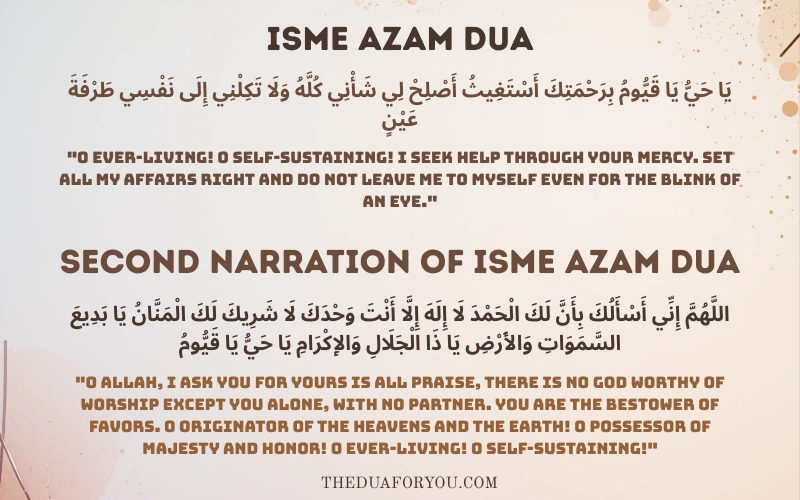
يَا حَيُّ يَا قَيُّومُ بِرَحْمَتِكَ أَسْتَغِيثُ أَصْلِحْ لِي شَأْنِي كُلَّهُ وَلَا تَكِلْنِي إِلَى نَفْسِي طَرْفَةَ عَيْنٍ
Transliteration
Ya Hayyu Ya Qayyum, bi rahmatika astaghees, aslih li sha’ni kullahu, wa la takilni ila nafsi tarfata ‘ayn.
Meaning
“O Ever-Living! O Self-Sustaining! I seek help through Your mercy. Set all my affairs right and do not leave me to myself even for the blink of an eye.”
Second Narration of Isme Azam Dua in Arabic
This second version is recorded in Sunan Abu Dawud (1496) and Jami at-Tirmidhi (3478). The Prophet ﷺ heard a man reciting this after his prayer and said:
“He has called upon Allah by His Isme Azam that name by which when He is supplicated, He answers.”
Arabic Text
اللَّهُمَّ إِنِّي أَسْأَلُكَ بِأَنَّ لَكَ الْحَمْدَ لَا إِلَهَ إِلَّا أَنْتَ وَحْدَكَ لَا شَرِيكَ لَكَ الْمَنَّانُ يَا بَدِيعَ السَّمَوَاتِ وَالأَرْضِ يَا ذَا الْجَلَالِ وَالإِكْرَامِ يَا حَيُّ يَا قَيُّومُ
Transliteration
Allahumma inni as’aluka bi-anna lakal hamda, la ilaha illa anta wahdaka la sharika lak, al-mannanu, ya badi’as samawati wal ard, ya dhal jalali wal ikram, ya hayyu ya qayyum.
Meaning
“O Allah, I ask You for Yours is all praise, there is no god worthy of worship except You alone, with no partner. You are the Bestower of favors. O Originator of the heavens and the earth! O Possessor of majesty and honor! O Ever-Living! O Self-Sustaining!”
Isme Azam Meaning: What Does It Actually Mean?
The term Isme Azam comes from two Arabic words: Ism (name) and Azam (greatest/most supreme). Together, it means “The Greatest Name of Allah.”
Scholars of Islam are largely in agreement that Al-Hayyu (The Ever-Living) and Al-Qayyum (The Self-Sustaining, the One who upholds all of creation) are the divine attributes at the core of Isme Azam.
These two names together carry a meaning that no other name combination holds:
- Al-Hayyu — Allah’s life is eternal, without beginning or end. He never sleeps, never tires, and never ceases.
- Al-Qayyum — He sustains, upholds, and governs every single thing in existence. Nothing stands except by His will.
When a servant calls upon Allah using these attributes, they are acknowledging that only He holds all power, all life, and all sustenance.
Isme Azam in the Quran
The Prophet ﷺ said that Isme Azam appears in three chapters of the Quran: Surah Al-Baqarah, Surah Aal-e-Imran, and Surah Taha (Mustadrak al-Hakim: 1866, Sunan Ibn Majah: 3856).
| Surah | Arabic | Reference |
|---|---|---|
| Al-Baqarah | اللَّهُ لَا إِلَهَ إِلَّا هُوَ الْحَيُّ الْقَيُّومُ | Ayat ul Kursi – 2:255 |
| Aal-e-Imran | الم ۚ اللَّهُ لَا إِلَهَ إِلَّا هُوَ الْحَيُّ الْقَيُّومُ | 3:1–2 |
| Taha | وَعَنَتِ الْوُجُوهُ لِلْحَيِّ الْقَيُّومِ | 20:111 |
The most famous of these is Ayat ul Kursi which itself begins with the declaration of Allah’s oneness and then immediately affirms that He is Al-Hayyu Al-Qayyum. This is no coincidence. It is a direct signal that these names hold a position above others in the Quran.
Isme Azam Dua Benefits
The isme azam dua benefits are rooted in authentic Islamic sources not tradition or folklore. Here is what the Quran and Sahih Hadith establish:
1. Dua Is Accepted
The most significant of all isme azam dua benefits is that when a person calls upon Allah using His Greatest Name, the supplication is accepted. The Prophet ﷺ stated this directly upon hearing a companion recite it (Tirmidhi: 3524). This alone makes the isme azam dua worth memorizing and practicing daily.
2. A Powerful Shifa Ki Dua
For those seeking healing whether for themselves or a loved one reciting Ya Hayyu Ya Qayyum as part of a shifa ki dua adds tremendous spiritual weight to the request. The name Al-Hayyu (The Ever-Living) is directly connected to the concept of life and healing, making this the most fitting shifa ki dua one can recite.
3. Relief from Anxiety and Distress
The Prophet ﷺ himself would recite Ya Hayyu Ya Qayyum bi rahmatika astaghees in moments of difficulty and worry (Tirmidhi: 3524). For anyone going through emotional hardship, anxiety, or grief, this isme azam dua brings a stillness to the heart that is difficult to describe but easy to feel.
4. Forgiveness of Sins
The Prophet ﷺ said: “Whoever says ‘Astaghfirullahil Azim Allazi La Ilaha Illa Huwal Hayyul Qayyum wa Atubu Ilayh’ his sins are forgiven even if they are as abundant as the foam of the sea.” (Abu Dawud: 1517) This combines istighfar with the Isme Azam itself.
5. All Affairs Set Right
The words “aslih li sha’ni kullahu” – “set all my affairs right” make this dua comprehensive. It is not a request for one thing alone. It is a complete submission asking Allah to take charge of every matter in a person’s life, big or small.
6. Closeness to Allah
Reciting the isme azam dua regularly draws a person closer to Allah. Knowing the isme azam dua meaning and reflecting on it during recitation builds a relationship of awe, love, and complete reliance on the Creator.
When to Read Isme Azam Dua
There is no single fixed time for reciting the isme azam dua it can be read at any moment. However, certain times carry greater spiritual weight:
Morning and Evening: This is an established Sunnah. Reciting Ya Hayyu Ya Qayyum in the morning and evening provides protection and barakah throughout the day (Nasai: Amal al-Yawm wal-Laylah, 46).
After Obligatory Prayers: When a person has just finished Salah, they are in a state of heightened nearness to Allah. This is an ideal time for the isme azam dua.
During Illness (Shifa Ki Dua): For a sick person or for someone praying on their behalf, reciting this as a shifa ki dua is deeply recommended. The attributes of Al-Hayyu and Al-Qayyum are directly connected to life and its sustenance.
In Moments of Hardship: Financial difficulty, family crisis, emotional pain whenever life feels too heavy, this dua is the remedy.
Tahajjud (Night Prayer): The last third of the night is when Allah descends to the lowest heaven and answers supplications. Reciting the isme azam dua during Tahajjud is among the best combinations possible.
On Fridays: Jumu’ah holds a special hour of acceptance for prayers. Reciting the isme azam dua during this window is highly beneficial.
How to Recite Isme Azam Dua: The Proper Way
Reciting isme azam dua is not complicated, but doing it with proper etiquette increases its acceptance:
- Be in a state of wudu (ritual purity) and face the Qibla if possible
- Begin with Bismillahir Rahmanir Rahim
- Send Salawat (Durood) upon the Prophet ﷺ
- Recite the isme azam dua in Arabic with full focus and awareness of the meaning
- Ask for your need with complete trust that Allah hears and answers
- Close with Durood upon the Prophet ﷺ again and say Ameen
The most essential ingredient is yaqeen certainty that Allah will respond. The Prophet ﷺ said: “Call upon Allah while being certain of the response.” (Tirmidhi: 3479)
Read Also: Labaik Allahuma Labaik Dua
Isme Azam Dua Bangla
For Bengali-speaking readers, the isme azam dua bangla translation of Ya Hayyu Ya Qayyum bi rahmatika astaghees is:
“হে চিরঞ্জীব! হে চিরস্থায়ী! আমি তোমার রহমতের মাধ্যমে সাহায্য প্রার্থনা করছি। আমার সকল বিষয় সংশোধন করে দাও এবং এক পলকের জন্যও আমাকে আমার নিজের উপর ছেড়ে দিও না।”
Second Narration of Isme Azam Dua in Bangla
” আল্লাহুম্মা ইন্নি আসআলুকা বিআন্না লাকাল হামদ, লা ইলাহা ইল্লা আন্তা, ওয়াহদাকা লা শরীকা লাক, আল-মান্নান, ইয়া বাদী‘আস সামাওয়াতি ওয়াল আরদ, ইয়া যাল জলালি ওয়াল ইকরাম, ইয়া হাইয়্যু ইয়া কাইয়্যুম।”
While understanding the isme azam dua meaning in your own language is helpful and encouraged, the dua itself should always be recited in Arabic the language of the Quran and Sunnah as this preserves the exact wording that the Prophet ﷺ taught.
Conclusion
The isme azam dua is one of the most precious supplications in the entire Islamic tradition. Backed by authentic Hadith from Tirmidhi, Abu Dawud, Nasa’i, and Hakim and rooted in Quranic verses including Ayat ul Kursi it represents a direct, powerful channel between the believer and Allah.
Whether you recite it as a shifa ki dua for healing, as a morning and evening dhikr, or in your deepest moments of need, the isme azam dua asks Allah through His most majestic attributes: Al-Hayyu the One who gives and sustains life, and Al-Qayyum the One who upholds everything in existence.
Understanding the isme azam dua meaning, memorizing the isme azam dua in Arabic, and making it a regular part of your daily worship is among the most rewarding habits a Muslim can build. Allah has promised to answer the one who calls upon Him. Isme Azam is the most honored way to call.
“And your Lord said: Call upon Me, I will respond to you.”
? FAQs
What is Isme Azam?
Isme Azam is the Greatest Name of Allah when used in supplication, it causes the dua to be accepted. According to the majority of Islamic scholars, the core of Isme Azam is Al-Hayyu Al-Qayyum, which appears in Ayat ul Kursi and multiple places in the Quran.
What is the Isme Azam Dua in Arabic?
The most authentic version is: يَا حَيُّ يَا قَيُّومُ بِرَحْمَتِكَ أَسْتَغِيثُ recorded in Tirmidhi (3524) with a sound chain of narration. A fuller version also appears in Abu Dawud (1496) and Tirmidhi (3478).
What is the Isme Azam Dua meaning?
It means: “O Ever-Living! O Self-Sustaining! I seek help through Your mercy.” It is a declaration of Allah’s absolute power and a humble acknowledgment of the servant’s complete dependence on Him.
Can Isme Azam Dua be used as a shifa ki dua?
Yes. Reciting Ya Hayyu Ya Qayyum as part of a shifa ki dua is well-established. The name Al-Hayyu (The Ever-Living) is directly related to the concept of life and health, making it among the most appropriate duas for seeking healing.
Is there a specific isme azam dua bangla version?
Understanding the dua in Bengali (isme azam dua bangla) for comprehension is beneficial. However, the dua should always be recited in Arabic to preserve the Prophetic wording and its spiritual impact.
Can any Muslim recite the Isme Azam Dua?
Yes. This dua is for every Muslim, regardless of age, gender, or background. The Prophet ﷺ himself recited it in times of difficulty, and his companions were taught it directly. Anyone can recite it with sincerity and full trust in Allah.
How many times should it be recited?
There is no fixed number stipulated in Hadith. It can be recited once, three times, seven times, or more based on your need and devotion. The quality of focus matters more than the quantity of repetition.