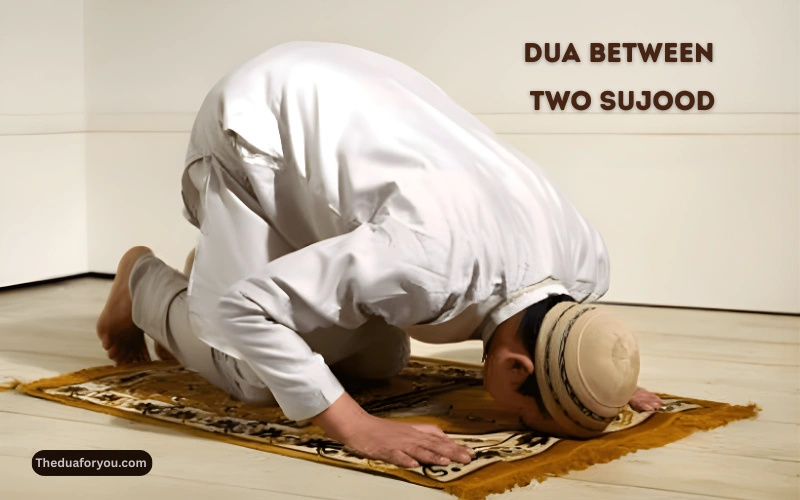
In every unit of Salah, after completing the first Sajdah (prostration), a Muslim sits briefly before going into the second Sajdah. This short sitting position is known as Jalsa and it is during this pause that a specific supplication is recited. This supplication is called the dua between two sujood.
This dua is a humble request to Allah for forgiveness, mercy, guidance, sustenance, and much more. It is a moment of deep connection between a servant and his Lord. Even though the sitting is brief, the words carried in this dua are full of meaning and sincerity.
Many Muslims are unaware of this dua or recite only “Allahummagh firli” without knowing the full, more complete version. Both versions are authentic and reported in reliable Islamic sources.
Dua Between Two Sujood in Arabic
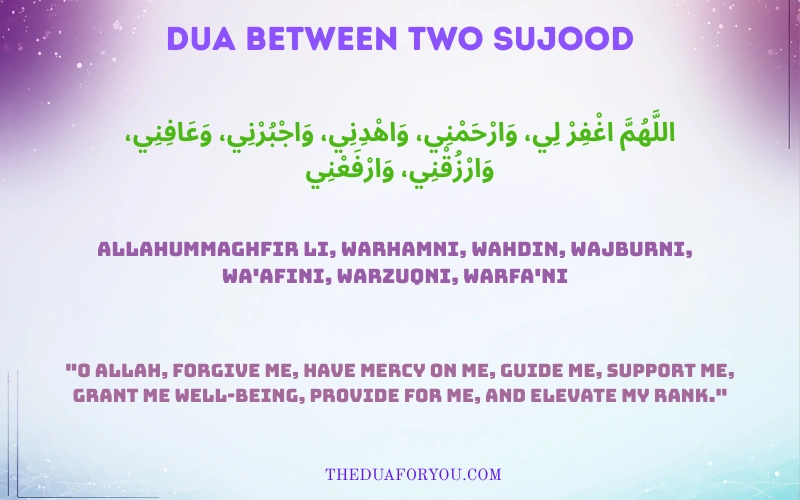
The more complete version of the dua between two sujood, reported in Sunan Abu Dawood and other hadith collections, is:
اللَّهُمَّ اغْفِرْ لِي، وَارْحَمْنِي، وَاهْدِنِي، وَاجْبُرْنِي، وَعَافِنِي، وَارْزُقْنِي، وَارْفَعْنِي
Dua Transliteration
For those who are still learning Arabic pronunciation, here is the easy Roman transliteration:
Allahummaghfir li, warhamni, wahdin, wajburni, wa’afini, warzuqni, warfa’ni
Dua Between Two Sujood Meaning in English
| Arabic Phrase | English Meaning |
|---|---|
| Allahummaghfir li | O Allah, forgive me |
| Warhamni | And have mercy on me |
| Wahdin | And guide me |
| Wajburni | And support me / mend my affairs |
| Wa’afini | And grant me well-being |
| Warzuqni | And provide for me |
| Warfa’ni | And elevate my rank |
In simple words, this dua asks Allah for seven great blessings: forgiveness, mercy, guidance, support, health, sustenance, and a higher status in this world and the Hereafter.
Shorter Version of Dua Between Two Sujood
A shorter but equally authentic version of the sitting between two sujood dua is:
اللَّهُمَّ اغْفِرْ لِي
Allahummaghfir li
“O Allah, forgive me.”
This shorter form is also reported authentically and is perfectly acceptable to recite, especially for those who are beginners or still memorizing the full supplication.
Why Dua Between Two Sujood Is Recited
The position between two Sujoods is called Jalsa. It is a Wajib (obligatory) act in Salah according to many scholars, and the dua recited during it holds great spiritual value.
Sajdah is the closest a servant comes to Allah. The Prophet Muhammad ﷺ said:
“The closest a servant is to his Lord is when he is in prostration.” (Sahih Muslim)
So when a Muslim rises from the first Sajdah and sits before the second, it is a moment to vocalize inner needs and ask Allah directly. The dua to recite between two sujood captures the most essential human needs pardon, compassion, direction, support, health, provision, and elevation.
This dua is not just words. It is an acknowledgment that everything a person needs in life forgiveness, guidance, health, rizq all comes from Allah alone.
When to Read Dua Between Two Sujood
The dua between two sujood is recited at one specific point in Salah:
- After completing the first Sajdah in any rak’ah
- While sitting in the Jalsa position with the right foot upright and left foot flat on the ground
- Before going into the second Sajdah
This applies to every rak’ah of Salah whether it is Fajr, Zuhr, Asr, Maghrib, or Isha. In a four-rak’ah prayer, this dua is recited four times in total, once in each rak’ah.
Important note: The Jalsa (sitting) itself is Wajib. The dua recited during it is Sunnah. Reciting this dua is following the practice of the Prophet ﷺ and adds great reward to the prayer.
Benefits of the Dua Between Two Sujood
The spiritual importance of this supplication is immense. Each part of the dua carries its own distinct blessing:
1. Forgiveness (Maghfirah)
Beginning the dua with a request for forgiveness reflects a believer’s awareness of their own shortcomings. Asking Allah for maghfirah keeps the heart clean and connected to repentance.
2. Mercy (Rahmah)
Asking for Allah’s mercy is asking for His all-encompassing love and care. Allah’s mercy covers every aspect of life in hardship, illness, loss, and longing.
3. Guidance (Hidayah)
A Muslim asks for guidance not just once in this dua, but reinforces it in every rak’ah. This shows how much a believer depends on Allah’s guidance at every step of life.
4. Support in Hardship (Jabr)
The word “Wajburni” comes from the root meaning to repair or mend what is broken. It is a request for Allah to fix what is difficult in one’s life whether in personal, family, or financial matters.
5. Well-Being (Aafiyah)
Good health is one of the most underappreciated blessings. This dua includes a sincere request for physical and mental well-being.
6. Sustenance (Rizq)
Asking Allah for rizq in Salah is a reminder that all provisions come from Him. It builds trust (tawakkul) and reduces anxiety about worldly needs.
7. Elevation of Rank (Rafa’)
This is a request for Allah to elevate the person’s status both in this world through honor and in the Hereafter through higher ranks in Jannah.
Reciting this dua between two sujood consistently in every Salah is a simple yet powerful act that keeps a Muslim humble, grateful, and spiritually aware.
Read Also: Khana Khane Ke Bad Ki Dua
Hadith Reference
This dua is reported on the authority of Ibn Abbas (رضي الله عنه). He narrated that the Prophet Muhammad ﷺ used to recite this supplication while sitting between the two prostrations.
Narrated by Ibn Abbas (RA): The Prophet ﷺ used to say between the two prostrations: “Allahummaghfir li, warhamni, wahdin, wajburni, wa’afini, warzuqni, warfa’ni.” (Sunan Abu Dawood, Hadith No. 850 | Classified as Hasan)
This confirms the dua to recite between two sujood is from the Sunnah of the Prophet ﷺ and backed by hadith.
Conclusion
The dua between two sujood is one of the beautiful hidden treasures within Salah. In just a few Arabic words, a Muslim asks Allah for everything that truly matters forgiveness, mercy, guidance, support, health, provision, and a higher station.
This short moment in Salah, the Jalsa, is not empty. It is filled with meaning when the sitting between two sujood dua is recited sincerely. Every Muslim who performs Salah has the opportunity, multiple times a day, to make this powerful supplication directly to Allah.
Memorizing and reciting this dua regularly can transform the quality of one’s Salah. It brings focus, humility, and a deeper sense of worship. May Allah accept our prayers, forgive our shortcomings, and grant us all that we sincerely ask of Him.
آمِيْن يَا رَبَّ الْعَالَمِيْن Ameen, O Lord of all the worlds.
? FAQs – Dua Between Two Sujood
Q1: Is it obligatory to recite the dua between two sujood?
No, reciting this specific dua is Sunnah, not Wajib. However, the sitting position itself (Jalsa) is Wajib in Salah. Reciting the dua is following the Sunnah of the Prophet ﷺ and earns extra reward.
Q2: What is the shortest dua that can be recited between two sujood?
The shortest authentic dua is: “Allahummaghfir li” meaning “O Allah, forgive me.” It is reported in authentic hadith and is acceptable to recite.
Q3: Can a person recite the dua between two sujood in their own language?
According to the majority of scholars, supplications in Salah that are part of the fixed Sunnah should be recited in Arabic. However, additional personal duas outside of the fixed structure can be made in one’s own language.
Q4: How long should one sit between two sujood?
The sitting should be long enough to be considered a proper pause at minimum, the duration it takes to recite “Subhan Allah” once. Reciting the full dua naturally fulfills this requirement.
Q5: Is this dua for all prayers including Sunnah and Nafl?
Yes. The dua between two sujood is recited in all types of Salah Fardh, Sunnah, Nafl, and Witr. It is a universal Sunnah of the Prophet ﷺ for every Salah.
Q6: What position should the hands be in while reciting this dua?
During the Jalsa (sitting between two sujood), the hands are placed on the thighs. The right hand can either be open or with the index finger pointing forward, according to different scholarly opinions.